I have seen countless founders waste months treating their website like a digital brochure rather than a working product. They hire a web design agency in New York to make things look pretty, only to find their core conversion problems remain completely untouched. Good design is about extreme clarity, not just aesthetics. In 2026, user expectations are ruthless. If your product positioning is messy, a fresh coat of visual paint will not save it. Here is how we think about choosing the right design partner, and the top firms delivering actual business value.
Quick answer
You need an agency that aligns precisely with your product maturity. Look for teams that challenge your assumptions, simplify the user experience, and drive measurable outcomes rather than just delivering visual assets. Here are the top providers right now.
Why do most startups fail when hiring a web design agency in New York?
Startups often fail here because they view design as a cosmetic layer. They believe a new color palette, scroll animations, and modern typography will magically fix their retention issues. This is a fundamental misunderstanding of what design actually does in a business context.
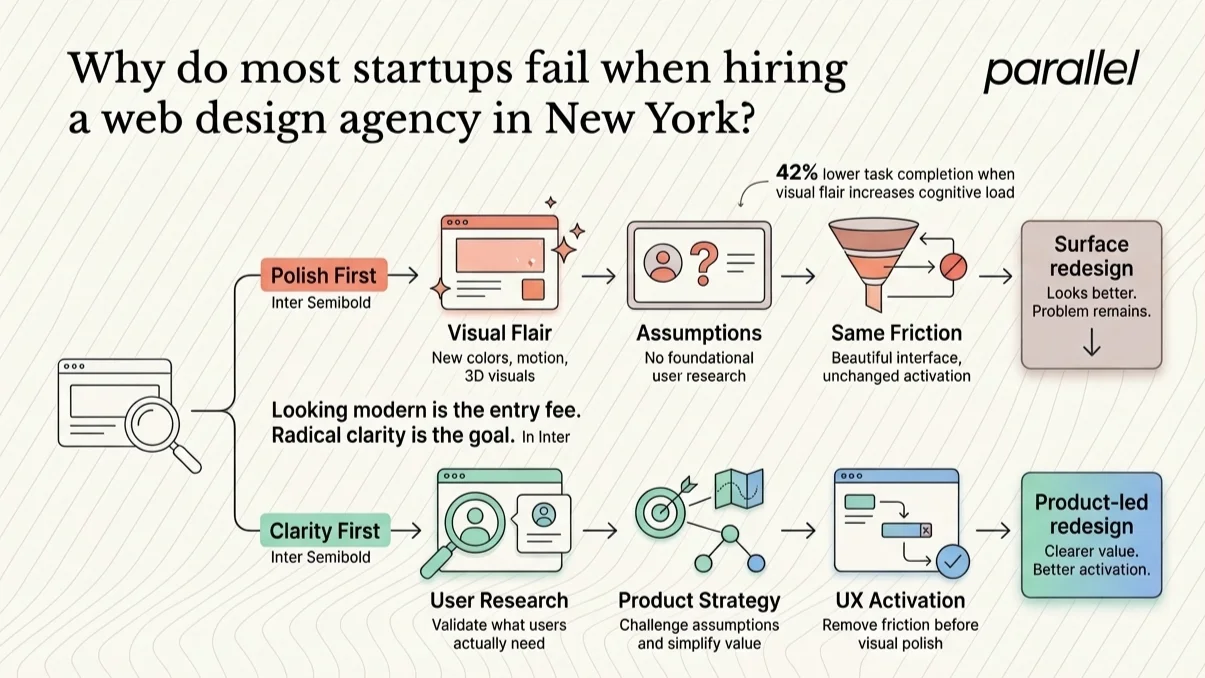
When a founding team lacks clarity in their product thinking, they instinctively try to mask it with visual complexity. They build intricate 3D landing pages and massive feature matrices. However, if the core value proposition is confusing, no amount of visual polish will convert a visitor into an active, paying user.
Do not hire a web design agency in New York just to make your UI look modern. Hire a partner to fix your UX gaps, challenge your core assumptions, and simplify your offering. The goal must always be radical clarity.
We have seen Series A teams spend six months rebuilding a platform only to see a zero percent lift in conversions upon launch. They skipped the foundational user research. They guessed what the user wanted, they instructed an agency to build it beautifully, and they failed completely because the product solved the wrong problem.
According to a 2025 Nielsen Norman Group study on cognitive load, interfaces that prioritize visual flair over functional simplicity see a 42% drop in task completion rates. Looking good is only the entry fee today. Users do not care about your custom cursor if they cannot figure out how to invite a team member to their workspace.
This data proves that if your site looks beautiful but fails to communicate immediate value, you lose the user forever. If you are looking to fix activation drops, you need a team that understands deep product strategy consulting. You need builders who will ask the hard questions about your business model, your customer acquisition cost, and your onboarding friction before they even open Figma.
How should you evaluate a web design agency in New York for real ROI?
How do you separate the strategic product partners from the simple pixel-pushers? You evaluate their operational process and how they define project success.
When you interview potential partners, ask how they measure success on day one. Are they measuring shipped screens and approved style guides, or are they measuring activated users and reduced support tickets? An agency focused strictly on output will talk endlessly about deliverables. A partner focused on outcomes will talk about user behavior and business metrics.
Here is a practical, three-step approach to vetting a design partner.
First, ask for a breakdown of a past failure. A mature team will tell you exactly what went wrong on a past project, why their initial hypothesis failed, and how they pivoted to fix it. Beware of teams that claim a perfect track record. Building software is messy, and anyone who says otherwise has not shipped enough real products.
Second, review their early project phases. Do they jump straight into wireframing based on your brief, or do they offer a structured discovery framework? If they do not spend time understanding your market constraints and speaking to your actual users, they are just guessing with your budget.
Third, test their business acumen. They should understand your customer acquisition cost, your lifetime value, and your churn rate. Every single design decision must be grounded in these financial realities. If a design choice does not aim to improve one of these metrics, it is just art.
The ROI of good design is massive when executed correctly. Forrester Research's 2026 UX ROI report shows that every dollar invested in strategic UX can yield up to a 100x return. That return only happens if the design solves a real friction point in the user journey. A strong web design agency New York will strip away the noise and tell you exactly what features you need to cut.
What is the core difference between surface design and product thinking?
We often see a harsh disconnect between a startup's marketing website and their actual software application. The website promises a magical, seamless experience. The product then delivers a confusing, cluttered dashboard that requires a user manual to navigate.
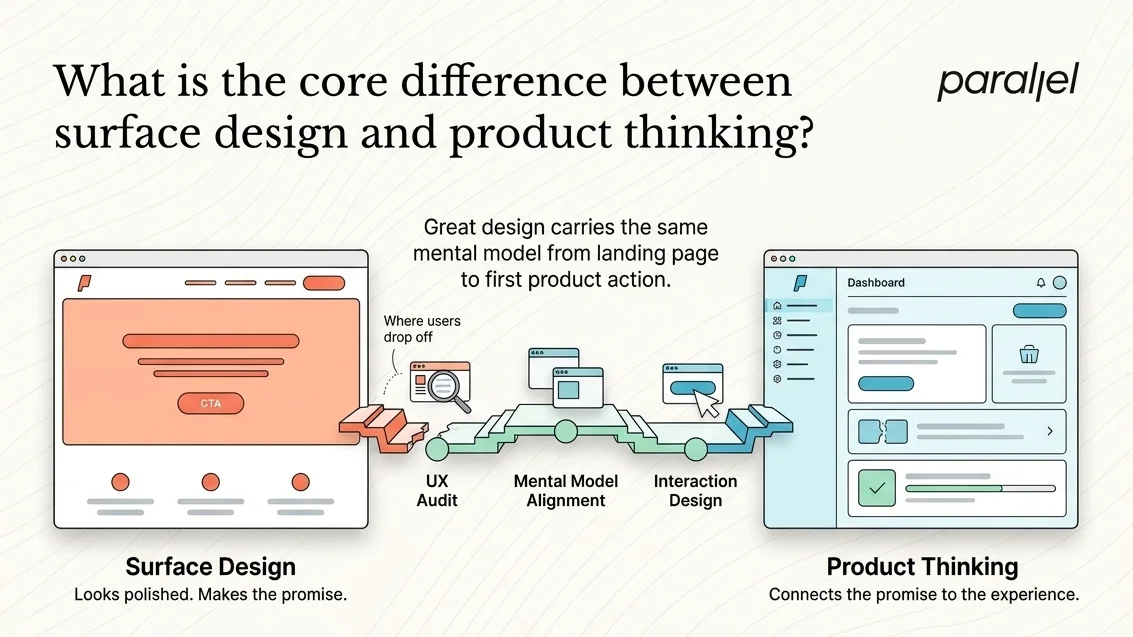
This happens because teams treat marketing site design and core product design as two completely different disciplines handled by different silos. In reality, they are a single continuum. The marketing website is simply step one of your user onboarding journey.
To fix this disjointed experience, we recommend starting with a comprehensive UX audit. Before you commission a massive website redesign, you must figure out exactly where users are dropping off. Are they confused by the pricing page architecture? Do they sign up successfully but fail to complete the first critical action inside the app?
Once you have this quantitative and qualitative data, you can build a cohesive transition from the landing page directly into the core application. We define a cohesive transition as one where the user's mental model matches the interface at every single step. The promises made in your hero copy must be immediately validated by the empty states in your software. This requires deep interaction design expertise, not just graphic design skills.
According to 2026 onboarding data from the Baymard Institute, poor usability and frustrating initial navigation drive over 68% of users to abandon software within the first ten minutes. This friction is entirely avoidable if you align your brand promises with your actual product capabilities. True product thinking bridges the gap between what you say you do and what the user actually experiences.
What specific metrics expose a bad digital design engagement?
If you want to know if your design investment is actually working, you have to look beyond subjective opinions. We tell founders to ignore whether they personally like the aesthetic and focus entirely on user behavior data. Bad design engagements are easily exposed by three specific metrics.
First is Time-to-Value (TTV). How long does it take a brand new user to experience the core benefit of your product? If your new onboarding flow looks gorgeous but adds three extra mandatory steps, you have increased your TTV. Good design reduces the time it takes for a user to reach that "aha" moment.
Second is your Activation Rate. This is the percentage of users who sign up and actually complete the specific actions necessary to become an active user. If a design agency redesigns your landing page and increases signups by 20%, but your activation rate drops because those new users are unqualified or confused by the product, the redesign was a failure. We frequently run SaaS onboarding teardowns to identify exactly where this activation leakage occurs.
Third is post-launch support ticket volume. A beautiful interface that generates a flood of "how do I do this" questions to your customer success team is a broken interface. Effective design anticipates user confusion and answers questions within the UI itself. When we engage in B2B CRO suggestions, reducing the burden on support teams is always a primary objective.
Who are the top 10 firms when you need a web design agency in New York?
Here is our curated list of the top 10 options if you need a web design agency New York. We selected these specific providers based on their strategic maturity, their ability to ship real working products, and their historical track record with complex business challenges.
1) ParallelHQ
I built ParallelHQ because I saw early-stage startups and product leaders constantly struggling with design decisions that should have been much simpler. We act as a dedicated product design and strategy partner. We do not just hand over a Figma file of visual assets and wish you luck with development.
We work closely with founders to clarify their core thinking and ground their UX decisions in real user behavior. Our focus is on simplifying complex logic, running B2B UX design initiatives, and utilizing high-impact design sprints to validate risky ideas fast.
We find that teams often overcomplicate their product experiences, especially when building AI or enterprise tools. Our job is to simplify the complex and ensure your product actually converts users into advocates. If you want a partner who challenges your assumptions and prioritizes radical clarity over passing design trends, we are your team.
2) Huge
Huge is a massive global player with a very strong historical presence in the city. They excel at massive enterprise digital transformations and large-scale consumer campaigns. They have built digital experiences for some of the most recognizable corporate brands in the world.
If you are a Fortune 500 company needing a complete organizational and brand overhaul, they have the vast scale and the resources to execute it. They bring deep analytics departments and massive user research teams to the table for multi-year engagements.
However, agile startups and mid-market SaaS companies might find their process heavy, expensive, and slow-moving. This is exactly why some growing tech companies look for a Huge alternative when they need faster iterations and leaner, more practical product strategy.
3) Work & Co
Work & Co is legendary in the industry for their ruthless focus on shipping actual digital products. They deliberately strip away typical agency account management layers and put clients directly in touch with the designers and engineers doing the work.
Their strict focus on highly functional, technically robust products makes them a top tier choice for companies that know exactly what they want to build. They do not get bogged down in theoretical brand exercises or fluffy strategy sessions. They design, prototype, and write code.
For early-stage teams needing more strategic product positioning before they start building, a Work & Co alternative might offer more hands-on startup guidance and fundamental market validation before writing expensive code.
4) R/GA
R/GA blends deep technological capability with high-end brand storytelling better than almost anyone else. They are incredible at creating innovative marketing experiences and connected digital ecosystems that span physical and digital touchpoints.
They thrive on complex, high-budget challenges where cutting-edge technology and creative advertising intersect. They are often the go-to agency for global consumer brands launching completely new, innovative digital initiatives.
If your project requires a nimble, lean startup approach focused strictly on core software usability, you may want to explore an R/GA alternative. Their immense scale and conceptual approach are often best suited for massive organizational campaigns.
5) Code and Theory
Code and Theory built their formidable reputation on designing massive content platforms and global publishing websites. They deeply understand how to structure complex information architectures for platforms that receive millions of daily readers.
If you have a content-heavy product, a media publication, or a complex editorial workflow, they are a proven and reliable entity. They know exactly how to keep readers engaged and how to optimize digital ad revenue through smart layout design.
Teams building highly transactional SaaS tools or specialized enterprise software sometimes require a different skill set. In those specific cases, founders often prefer a Code and Theory alternative that specializes exclusively in application workflows and state management.
6) Instrument
Instrument sits beautifully at the intersection of brand and product. They build narrative-driven digital experiences for top global lifestyle and technology brands. Their work is consistently polished, visually striking, and emotionally resonant.
They excel at translating a physical brand's ethos into a digital environment. They are great storytellers who use digital interfaces as their primary medium, ensuring that every touchpoint feels distinctly on-brand.
If you need deep, complex SaaS logic simplified for a strict B2B enterprise audience, an Instrument alternative focused specifically on utility software might be a better operational fit for your needs.
7) Method
Method focuses heavily on strategic service design and comprehensive customer experience architecture. They look at the entire lifecycle of a customer across multiple physical and digital touchpoints, not just the pixels on a screen.
This holistic approach makes them fantastic for complex service businesses like healthcare networks or legacy finance institutions. They map out the invisible operational processes that support the user experience.
For rapid software prototyping and fast-to-market execution, a Method alternative could be more practical for an early-stage startup running on a tight financial runway.
8) Frog Design
Frog Design has deep, historic roots in industrial design, which heavily influences their rigorous approach to digital work. They bring a highly researched, academic methodology to interface design and user experience.
They are excellent for projects bridging hardware and software, such as medical devices, automotive interfaces, or connected home products. Their attention to human factors and ergonomics is unmatched in the industry.
Teams building pure-play SaaS without a hardware component might seek a Frog Design alternative to avoid paying for industrial design overhead and hardware research frameworks they do not need.
9) Ramotion
Ramotion specializes in brand identity, UI/UX design, and web development tailored specifically for growing tech companies. They are widely known for creating incredibly slick, high-converting marketing sites for B2B SaaS companies.
They produce beautiful, modern aesthetics that instantly make young startups look like established enterprise players. They are very effective at visual positioning and creating trust through high-end interface design.
If you need deep product application design beyond the marketing site and user onboarding, a Ramotion alternative might provide broader software workflow expertise for complex post-login experiences.
10) Neuron
Neuron is highly focused on B2B UX design and specialized workplace tools. They deeply understand how to untangle complex dashboards, massive data tables, and convoluted enterprise workflows.
They are a great choice for internal tools and proprietary software that requires high user efficiency and low error rates. They prioritize function and clear data visualization over flashy marketing elements.
If you need a partner that blends consumer-grade brand storytelling with your utility product UX, a Neuron alternative might be necessary to balance both sides of the product equation.
Conclusion
Choosing a design partner is rarely about finding someone who knows the latest Figma plugins better than you do. It is entirely about finding a partner who thinks clearly about your business mechanics. Visuals matter immensely, but clarity is what actually drives revenue. We have seen too many founders burn precious runway on beautiful websites that fail to convert because the underlying product strategy was ignored. Fix the thinking first. The design will follow naturally.
Frequently asked questions
1) What does a typical web design agency in New York charge in 2026?
Pricing varies wildly based on agency size and project scope. Most reputable, strategic agencies in this market start foundational engagements around $30,000 to $50,000. Complex SaaS product redesigns or deep digital transformations often scale well past $150,000. The cost depends entirely on the depth of the initial UX audit, the amount of primary user research required, and the technical complexity of the final build. Do not shop on price alone, shop on the expected return on investment.
2) How long does a strategic redesign project take?
A proper product redesign, grounded in actual market research rather than assumptions, typically takes between 8 to 16 weeks from kickoff to final handoff. Rushing this process usually results in skipped market validation and poor conversion rates upon launch. The discovery phase alone should take a few weeks if the agency is properly auditing your current user behavior and mapping out necessary workflow changes.
3) What is the difference between UX design and web design?
Web design historically focuses on the visual presentation, branding, and structural layout of a marketing site. It aims to generate interest and capture leads. UX design focuses on the psychology, behavior, and specific friction points of the user journey across the entire digital ecosystem. UX dictates how a product works and feels, while traditional web design dictates how it looks to the outside world.
4) How do I know if I need a product designer or a marketing web designer?
If your primary business goal is to generate top-of-funnel leads, tell a compelling brand story, and optimize search traffic, you need a marketing web designer. If your goal is to improve software activation rates, increase long-term user retention, simplify complex dashboard workflows, and reduce customer support queries, you absolutely need dedicated product design services.
5) Is this the right time for my startup to invest in a UX audit?
If you are seeing high marketing traffic but low trial conversions, or if users are consistently abandoning your onboarding flow before experiencing value, it is time for an audit. An audit identifies the precise friction points using real data before you spend money on costly development cycles. We frequently recommend audits for teams preparing for Series A funding who need to prove their core product loop is sticky and scalable.
6) Should we hire an agency or build an in-house design team?
Early-stage teams often benefit from an agency partner to establish the foundational design systems, validate the product strategy, and set the initial quality bar without the overhead of full-time salaries. Once the core loop is validated, revenue is scaling, and you need constant, daily iteration on micro-features, hiring an in-house team makes sense for long-term maintenance.
7) What are the signs that a web design agency in New York is the right fit for my startup?
The right partner will push back on your initial ideas. They will ask uncomfortable questions about your business model, your user acquisition strategy, and your technical constraints before they ever discuss typography or color palettes. They will insist on talking to your actual users. If an agency agrees with everything you say and simply promises to make your sketches look pretty, they are order-takers, not strategic partners.
8) Why choose ParallelHQ over a traditional digital agency?
We do not just execute visual deliverables to check a box. We act as a strategic partner to clarify your product thinking from the ground up. We utilize highly focused methods like design sprints to validate critical decisions quickly with real users, ensuring we build what actually works in the market. We are built for founders who want to simplify their product and drive real business outcomes, not just win design awards.

check out these related blogs




.webp)