I see founders struggle with product decisions every day. They build features no one uses. They overcomplicate onboarding flows. They hire agencies that deliver pretty screens but terrible unit economics. If you want to build something people actually use, you need clarity. This article is your exact what is product design? a founder's guide. It cuts through the industry noise. We will look at what actually drives retention and activation in early-stage startups. Good design is just good business logic made visible. Let us break down how to get it right.
Quick answer
Looking for a quick answer to what is product design? a founder's guide? Product design is the process of aligning user needs with business goals. It solves real problems through clear structure, user research, and logic. It is never just about visual aesthetics.
Why does product design matter for founders right now?
Most founders severely underestimate the cost of bad design. They view user experience as a luxury to address after achieving product-market fit. This mindset usually leads to high customer acquisition costs and massive churn. Design is not the paint you apply at the end. Design is how the engine actually works.
Recent data from the 2025 McKinsey Design Index shows that companies prioritizing user experience outperform their peers by 32% in revenue growth. People have less patience for clunky software than ever before. If your core user flow is broken, users will simply leave for a competitor.
Writing this what is product design? a founder's guide felt necessary because I constantly see teams burning cash on the wrong priorities. They spend weeks arguing over button colors. Meanwhile, their users cannot figure out how to reset a password or complete a basic transaction. You need to focus on usability first.
Good product design acts as a forcing function for business clarity. When you map out a user journey, you expose all the logical gaps in your business model. This forces you to answer hard questions early. It saves engineering hours that would otherwise be wasted on building useless features.
Table: Visual-first vs System-first product thinking
If you want to understand how deep these structural issues go, you should consider a proper UX audit. It will reveal exactly where your users are dropping off and why.
Where do startup teams go wrong with product design?
The most common mistake I see is confusing UI with UX. Founders want the product to look fresh and innovative. They forget that users just want to complete a task quickly and get on with their day. Familiarity beats novelty almost every time.
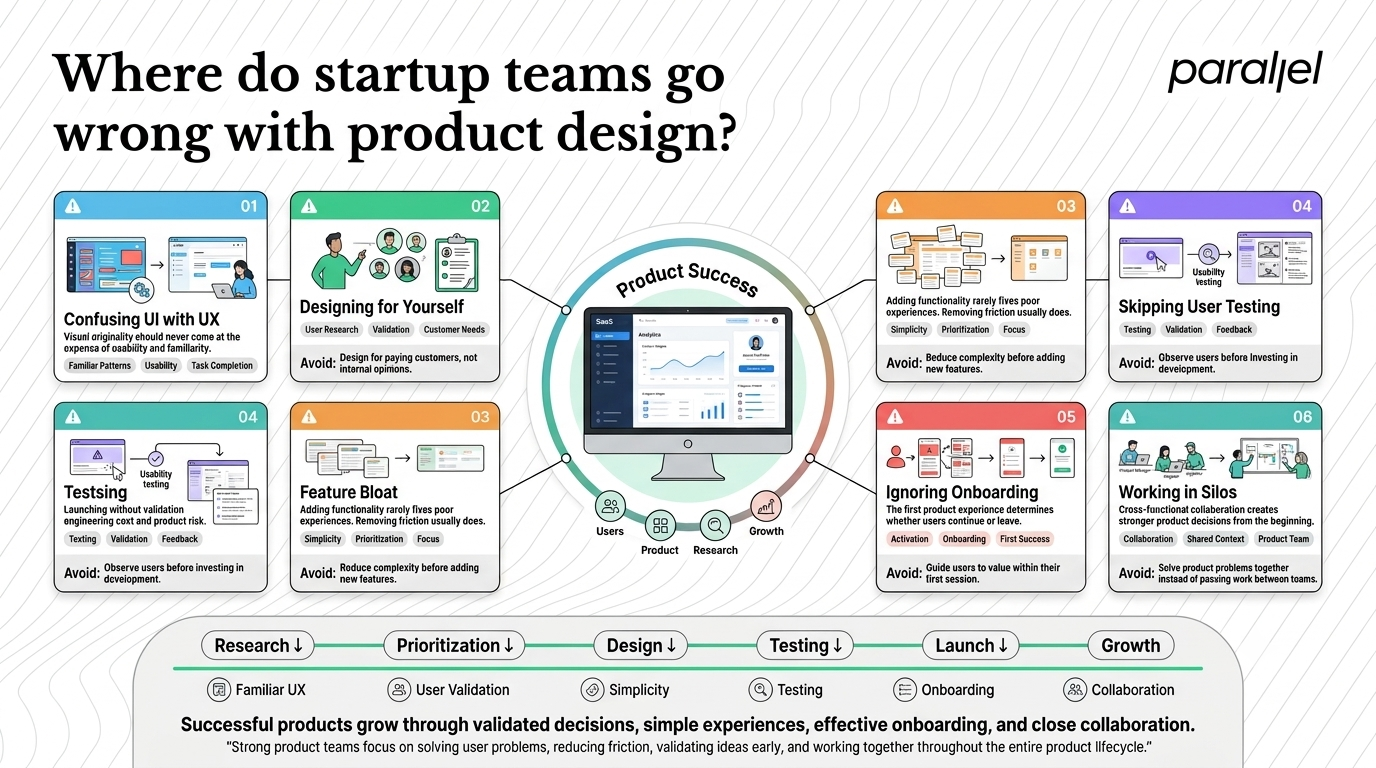
We recently did an audit for a B2B SaaS tool. Their team spent three months perfecting a custom, non-standard navigation menu. They thought it made them look cutting-edge. Users absolutely hated it. Activation dropped by 40% because people could not find the core features.
A core lesson in this what is product design? a founder's guide is that you should never reinvent the wheel unless the wheel is fundamentally broken. Standard UI patterns exist because they work. Your innovation should live in the value you provide, not in how a user opens a dropdown menu.
Here are the specific traps early-stage teams fall into:
- Designing for the founder: You are not your user. Building what you like often isolates the people who actually pay for your product.
- Feature bloat: Adding more features is the lazy way to solve retention problems. Removing friction requires actual product discipline.
- Skipping user testing: Launching without testing is just guessing with expensive engineering resources.
- Ignoring onboarding: The first five minutes dictate the next five months of a user's lifecycle.
Startups also fail by operating in silos. The product manager writes requirements, the designer colors them in, and the engineer builds them. This assembly line approach destroys context. Great product design requires all three disciplines to solve the problem together from day one.
If you struggle with user retention in your software, looking into a SaaS onboarding teardown is usually the best place to find quick wins. The biggest leaks always happen at the front door.
How should you think about product design correctly?
Think of product design as a system of decisions. You are balancing competing constraints to find the optimal path for a user. IDEO famously defines design thinking as the intersection of desirability, feasibility, and viability. As a founder, you must balance these three perfectly.
When people ask me for a what is product design? a founder's guide, I always tell them to start completely in the problem space. Do not jump into Figma to push pixels. Map the user journey first. Understand the exact context in which a user opens your application.
If a user signs up for your app, what is the single most valuable action they need to take? We call this the "aha moment." Every single design decision should optimize for getting the user to that moment as fast as possible. Anything that distracts from this goal must be removed.
We helped a fintech client map their core investment flow last year. They had a beautiful interface, but users were dropping off before funding their accounts. By removing three completely unnecessary steps and simplifying the copy, their conversion rate increased by 22%.
Here is how you should structure your internal thinking:
- Business goal: What metric are we trying to move?
- User problem: What is preventing the user from achieving this?
- Hypothesis: If we change X, we believe Y will happen.
- Experiment: Let us design the smallest possible test to prove this.
This methodical approach is the core of solid product strategy consulting. It removes ego from the process. It forces the team to rely on data and observed human behavior rather than internal opinions.
What are the practical steps to implement product design?
You need a repeatable framework. Do not guess what users want. Test it rigorously before committing engineering time. Writing code is the most expensive way to test a hypothesis. Designing a prototype is infinitely cheaper.
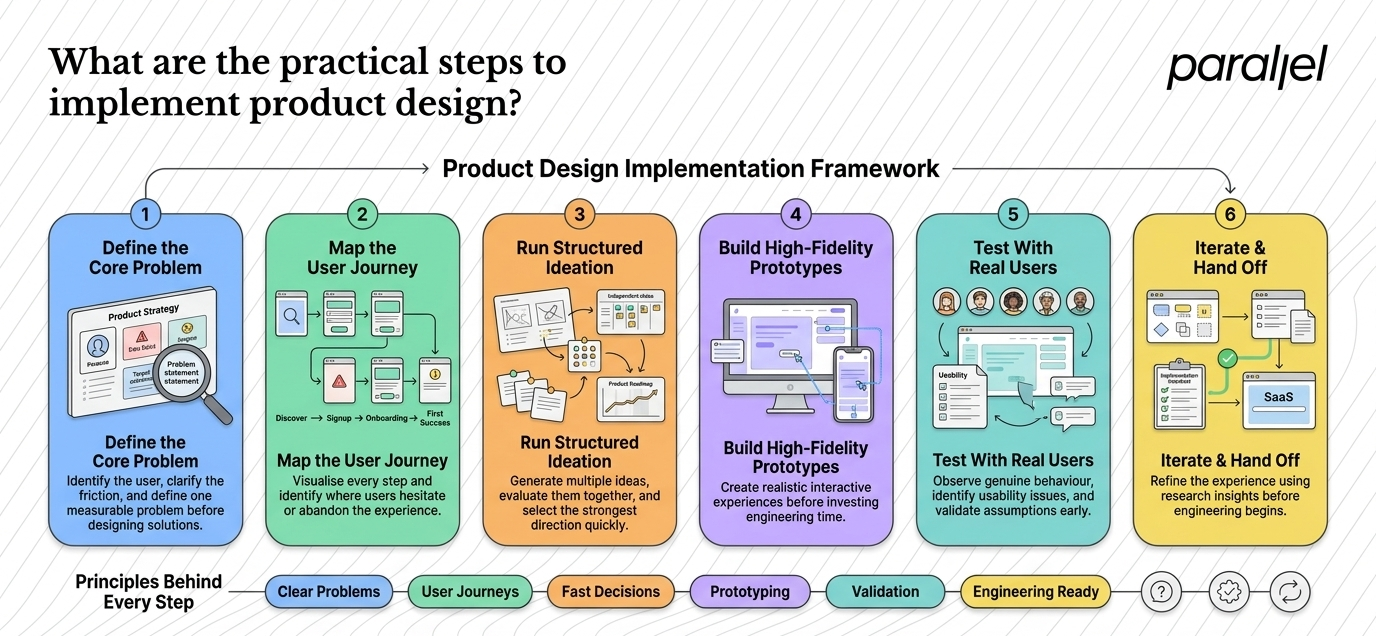
The most actionable part of any what is product design? a founder's guide is the execution plan. Here is the exact methodology we use to help startup teams simplify complex problems and ship better products faster.
1) Define the core problem clearly: Never start designing without a clear problem statement. If the problem is vague, the solution will be messy. Define the exact user persona and the specific friction point they are experiencing right now.
2) Map the critical user journey: Draw out the exact steps a user must take to solve their problem. Use simple boxes and arrows. Identify where the drop-offs happen. This step requires brutal honesty about your current product experience.
3) Run a structured ideation phase: Bring your PMs, designers, and engineers into a room. Sketch solutions independently, then vote on the best concepts. We rely heavily on design sprints to compress months of debate into a few focused days of decision making.
4) Build high-fidelity prototypes: Take the winning concepts and build a realistic prototype. It should look and feel exactly like a real product. The user should not be able to tell that it is just a series of linked images.
5) Test with five real users: The Nielsen Norman Group established decades ago that testing with just five users uncovers 85% of usability issues. Watch them try to complete core tasks. Do not guide them. Just observe where they get stuck and ask them to think out loud.
6) Iterate and hand off: Take the qualitative data from your user tests and fix the broken flows. Only then should you prepare detailed documentation for your engineering team.
This structured approach is how you transition from guessing to knowing. If you are building a new feature from scratch, looking into MVP development structured around these principles will save you massive amounts of runway.
How does AI change the product design landscape in 2026?
Artificial intelligence is fundamentally shifting how we build and research products. However, the core principles of human psychology remain exactly the same. Tools are getting faster, but the strategic thinking behind the tools is more important than ever.
Researching for this what is product design? a founder's guide, I found that high-performing teams use AI for leverage, not for strategy. A 2026 industry report indicates that 65% of top-tier product teams now use AI for qualitative data analysis. They use it to synthesize user interviews and identify patterns at scale.
AI cannot replace user empathy. It can process a transcript in seconds, but it cannot read the hesitation or frustration on a user's face during a live usability test. You must stay close to your customers.
Use AI to speed up your workflow. Generate UI variations quickly. Automate your documentation. But do not use it to outsource your core product thinking. If you let an algorithm decide your product strategy, you will end up building a generic product that nobody loves.
For teams looking to integrate these new workflows, partnering with an AI native design agency can help bridge the gap between emerging technology and fundamental usability principles.
Conclusion
Building a successful startup is incredibly difficult. Do not let bad design make it harder than it needs to be. Start with clear, logical thinking. Focus entirely on real user behavior and ignore the superficial industry trends.
I hope this what is product design? a founder's guide helps you make sharper, more confident decisions. Good product design is never an accident. It is simply the natural byproduct of understanding your user deeply and removing the obstacles in their way. Keep it simple, test everything, and let the clarity of your thinking speak for itself.
FAQs
1) What is the basic definition of product design?
The simplest definition in this what is product design? a founder's guide is that it is a holistic approach to creating products. It solves real user problems while hitting specific business goals through research, logical flows, and interface creation.
2) How do I start the product design process?
Start by defining the exact problem. Talk to five target users before you do anything else. Build a simple prototype and test it. Do not open design software until you know exactly what problem you are solving.
3) How does product design compare to graphic design?
Graphic design primarily focuses on visual communication and brand perception. Product design focuses on functionality, system logic, and user behavior. Graphic design asks how something looks. Product design asks how it works.
4) Is product design right for my early-stage startup?
Yes. Early-stage startups need product design more than anyone else. If your initial product is hard to use, you will quickly lose your early adopters. Good design reduces churn and drastically increases user activation.
5) How long does a typical design sprint take?
A standard design sprint takes about four to five days. It allows your team to define a complex problem, sketch potential solutions, build a realistic prototype, and test it with real users very quickly.
6) What metrics should I track to measure design success?
Focus on task completion rate, time on task, and overall user retention. Avoid vanity metrics like page views. If users cannot complete their primary goal quickly, your design has fundamentally failed.
7) Should I hire an in-house designer or an agency?
It depends entirely on your current stage. Early on, a strategic agency can help you find product-market fit much faster. Once you scale and secure funding, building an in-house team makes sense for long-term product maintenance.
8) How can ParallelHQ help with my startup's design?
As highlighted throughout this what is product design? a founder's guide, ParallelHQ focuses on absolute clarity and strong decision-making. We help founders simplify complex products, run effective design sprints, and build experiences deeply grounded in real user behavior.

check out these related blogs


















.webp)