Over the last decade, I have seen early-stage teams waste months picking a design partner based on flashy portfolios rather than real product thinking. When founders look for a Los Angeles web design company, they usually get caught up in aesthetics. But a beautiful website will not fix weak onboarding, messy architecture, or low activation rates. You do not just need a vendor. You need a partner who understands user behavior and business goals. Let us look at the teams actually driving product clarity and measurable outcomes in 2026.
Quick answer (TL;DR)
Finding the right Los Angeles web design company means looking beyond UI trends to focus on strategic product execution. Here is a comparison of the top 10 partners who excel at translating complex problems into clear user experiences.
Why is finding the right Los Angeles web design company so difficult for startups?
The design industry has a clarity problem. Many agencies prioritize visual flair over functional problem-solving. This creates a dangerous trap for early-stage founders who need a product that actually converts users, not just one that looks good on a design inspiration site.
We frequently see teams inherit products that are visually stunning but structurally broken. The navigation is confusing. The core value proposition is hidden. The onboarding flow asks for too much information upfront. These are the symptoms of hiring a partner who thinks in terms of static screens rather than user journeys.
Real product design requires a deep understanding of human behavior. It demands asking hard questions about business models and technical constraints. A 2026 study by Forrester Research highlighted that every $1 invested in UX design yields a return of $100. This 9,900% ROI only happens when teams prioritize usability and friction reduction.
When you hire a partner based solely on their visual style, you miss out on this strategic value. You end up with a team that agrees with all your feature requests instead of challenging your assumptions. True clarity comes from removing the unnecessary so the essential can speak.
Where do founders go wrong when choosing a Los Angeles web design company?
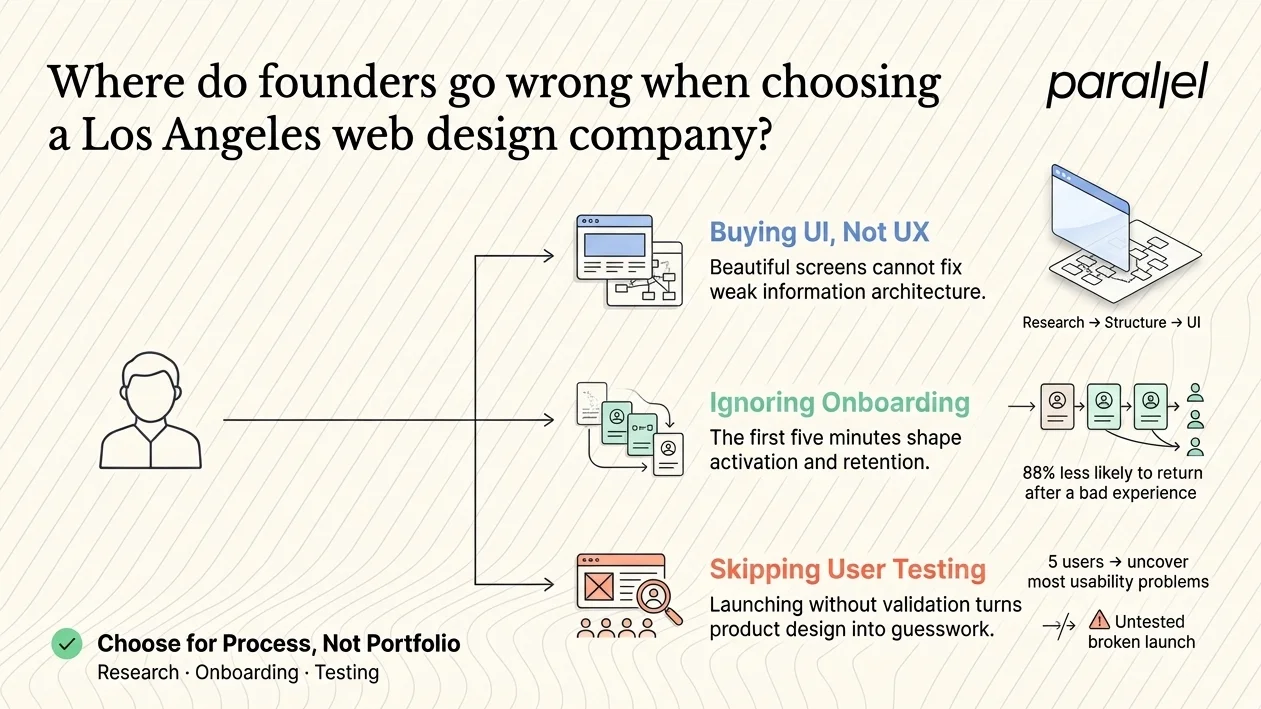
Most product decisions go wrong long before a single wireframe is drawn. Founders often rush the vendor selection process, looking for the fastest or most visually impressive option. In my experience, this leads to three highly predictable mistakes.
Mistake 1: Buying UI instead of UX architecture
Founders frequently mistake a slick user interface for good user experience. They look at an agency portfolio and assume those beautiful screens will translate into business success. However, UI is just the final coat of paint. If the underlying information architecture is messy, the product will fail.
We have audited dozens of SaaS platforms that looked modern but had catastrophic churn rates. Users could not figure out how to complete their primary tasks. You must prioritize partners who start with user research and structural wireframing before they ever open a visual design tool.
Mistake 2: Treating onboarding as an afterthought
Activation is the most critical metric for any new product. Yet, many teams spend 90% of their budget designing the core dashboard and only 10% on the onboarding flow. They assume users will figure it out. This is a fatal flaw.
Recent 2026 industry data shows that 88% of users are less likely to return to a site after a single bad experience. If your design partner is not obsessing over the first five minutes of the user journey, they are setting you up for failure. A strong partner will advocate for a seamless, guided introduction to your product.
Mistake 3: Skipping usability testing to save time
Startups love speed. Many founders believe they can skip user testing because they understand their target audience perfectly. They hire a design team, build the product in a vacuum, and launch it to the public, hoping for the best.
This approach is basically gambling. The Nielsen Norman Group has consistently proven that testing with just five users uncovers 85% of usability issues. Skipping this step is the fastest way to build something nobody wants. Always look for a partner who integrates testing into their core process.
Who are the top 10 experts you should consider when hiring a Los Angeles web design company?
Choosing the right partner depends entirely on your specific stage and business goals. Here are the 10 teams leading the industry in 2026, categorized by their distinct strengths.
1) ParallelHQ
At ParallelHQ, we focus on clarity in product thinking. We partner primarily with founders and product leaders at early-stage startups and scaling SaaS companies. Our goal is to help teams simplify complex product experiences and make better design decisions.
We do not do agency fluff or trend-chasing. Instead, we ground our work in real user behavior. Whether we are running a UX audit to identify conversion blockers or redesigning a complex B2B dashboard, our approach remains the same. We prioritize usable, scalable solutions over flashy aesthetics.
Our team works closely with yours to reduce onboarding friction and improve activation rates. We believe that good design is ultimately about good decision-making.
2) Clay
Clay has built a massive reputation for high-end visual design and brand makeovers. They are known for creating incredibly polished, motion-heavy digital experiences that win awards. If your primary goal is to look like a top-tier tech unicorn from day one, they are a strong contender.
However, their approach leans heavily toward aesthetics. While they produce stunning work, startups needing deep, complex product architecture might find their focus on visuals overriding the functional needs. We often recommend looking at a Clay alternative if you need a stronger emphasis on underlying UX strategy and user testing.
3) Work & Co
Work & Co is a powerhouse in the digital product development space. They are deeply focused on shipping products and have a reputation for excellent technical execution. They work with some of the largest enterprise brands in the world to overhaul their digital ecosystems.
Their process is highly structured and rigorous. They are fantastic for massive, multi-year digital transformation projects. For an early-stage startup, however, their enterprise-level processes can sometimes feel too rigid and costly. Startups looking for a more agile, iterative approach might prefer a Work & Co alternative that moves at the speed of a seed-stage team.
4) R/GA
R/GA is an iconic agency with a long history of blending technology, design, and advertising. They excel at creating global brand campaigns that have a strong digital component. They are brilliant at telling brand stories through interactive web experiences.
Their strength lies in marketing and brand perception. If you need a website that functions as a highly interactive advertisement, R/GA is world-class. But if you are building a complex SaaS tool or a heavy utility application, their advertising DNA might not be the best fit. In those cases, exploring an R/GA alternative focused purely on product design is a safer bet.
5) Huge
Huge is a massive global agency known for large-scale experience design. They handle everything from digital strategy to physical retail experiences for Fortune 500 companies. They have the resources to tackle incredibly complex, multi-faceted business challenges.
Because of their size, you are often paying for massive overhead and layers of account management. While their work is undoubtedly high quality, the lack of direct access to the actual makers can be frustrating for startup founders. Teams needing a leaner, more direct partnership often seek a Huge alternative for faster communication and execution.
6) Method
Method focuses heavily on strategic design and bridging the gap between physical and digital products. They take a highly academic, research-driven approach to solving business problems. They are excellent at uncovering deep market insights and translating them into long-term product roadmaps.
Their discovery phases are extensive and thorough. While this is great for highly ambiguous, blue-sky innovation projects, it can be too slow for startups needing to launch an MVP quickly. If you need to move from concept to shipping product in weeks rather than months, a Method alternative might be more practical.
7) ustwo
ustwo gained global fame through their hit game Monument Valley. They have successfully translated that consumer-focused DNA into a digital product studio. They excel at building highly engaging, delightful mobile apps and consumer platforms.
They understand emotional design better than almost anyone else in the market. If you are building a consumer app that relies on gamification and daily habits, they are a fantastic choice. For enterprise software or complex B2B platforms, their consumer-heavy style might feel misaligned, making a ustwo alternative a better fit for heavy utility products.
8) Instrument
Instrument is a digital brand and experience agency that builds beautiful, story-driven web platforms. They work heavily with lifestyle and apparel brands to create immersive e-commerce experiences. They are masters of blending high-quality video, photography, and interactive web elements.
Their work is emotionally resonant and visually striking. If your brand relies entirely on storytelling and visual impact, they deliver incredible results. However, if your product is a technical tool that requires complex data visualization, their storytelling approach may not solve your functional problems. You might want to consider an Instrument alternative that specializes in functional architecture.
9) Neuron
Neuron is a highly specialized agency that focuses almost exclusively on B2B UX design. They tackle complex software interfaces, enterprise dashboards, and internal business tools. They are not chasing flashy consumer trends.
They understand how to organize massive amounts of data into usable screens. If you are building a highly technical, data-heavy product, they are a very solid, pragmatic choice. Their visual design can sometimes lean toward the conservative side, so if you need a highly distinct brand identity alongside your B2B tool, you might also look at a Neuron alternative.
10) Code and Theory
Code and Theory is a digital engineering and design firm known for handling massive media and publishing ecosystems. They have redesigned some of the most highly trafficked news and content websites on the internet. They excel at managing complex content taxonomies and advertising integrations.
Their expertise in content strategy is unmatched. If you are launching a media platform, they are the gold standard. For startups building software-as-a-service products, their heavy media focus is less relevant. In those scenarios, a Code and Theory alternative focused on SaaS metrics and user retention will provide better strategic value.
How should you evaluate your next Los Angeles web design company?
Evaluating a design partner requires cutting through their sales pitch to understand how they actually think. You need to see past the polished case studies and look at their decision-making process. Here is how we recommend evaluating any potential partner.
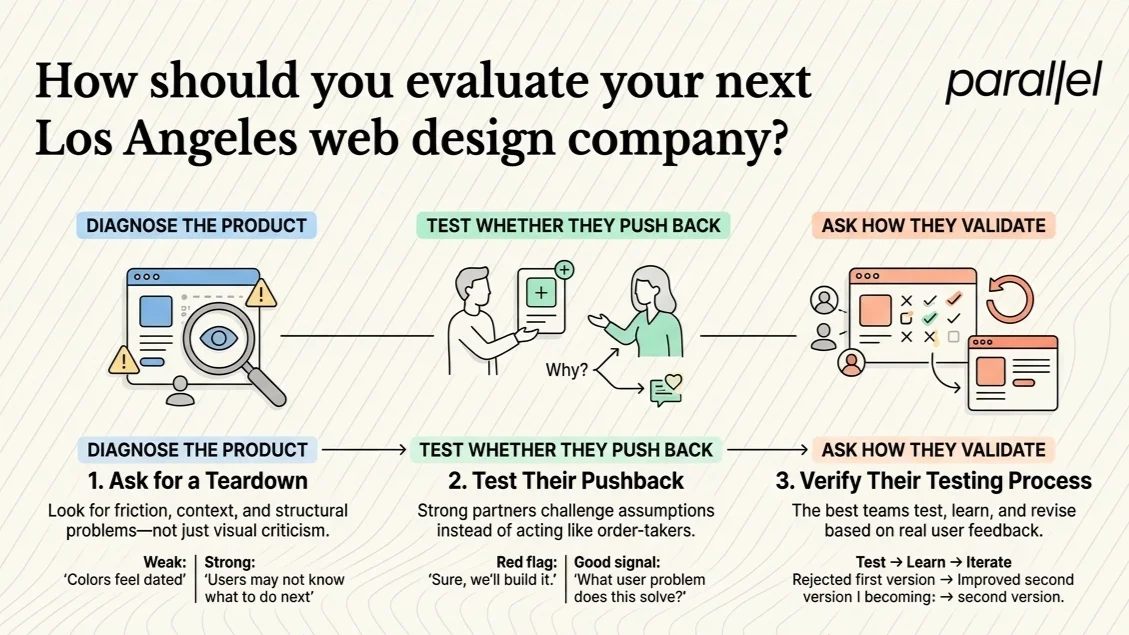
First, ask them to do a brief teardown of an existing product. It does not have to be your product. Give them an app you both use and ask them what is wrong with it. If they only point out bad colors or outdated typography, walk away. You want a partner who immediately identifies friction points, confusing copy, or missing user context.
Second, evaluate their willingness to push back. During your initial calls, suggest a feature that you know is a bad idea. See how they react. If they immediately agree to design it without asking why, they are just order-takers. A strong product strategy consulting partner will challenge your assumptions and protect the user experience from feature bloat.
Finally, look at how they validate their work. Ask them to explain a time they designed something that failed in user testing. If they claim everything they design works perfectly on the first try, they are lying. The best teams rely on iterative testing and are comfortable pivoting based on real user feedback.
Conclusion
Building a successful digital product requires much more than a fresh coat of paint. It requires a fundamental commitment to clarity, usability, and strategic thinking. The teams that succeed are the ones that ruthlessly eliminate friction and respect their users' time.
Do not let impressive visuals distract you from solving the core problems of your business. The right design partner will help you navigate complexity, validate your assumptions, and build a foundation that actually scales. Choose the team that asks the hardest questions, and let their strategic thinking guide your product to success.
Frequently Asked Questions
1) What exactly does a Los Angeles web design company do?
A standard agency designs the visual layout and builds the front-end code for a website. A strategic product design company goes much deeper. They conduct user research, define the product architecture, map out user journeys, and create tested prototypes before finalizing any visual interface.
2) How long does a typical product design project take?
Timelines vary widely based on scope and complexity. A rapid design sprint to validate a core concept can take just one to two weeks. A comprehensive redesign of an existing SaaS platform typically requires eight to twelve weeks of dedicated research, design, and testing.
3) How much does a Los Angeles web design company charge?
Pricing depends heavily on the agency model. Traditional agencies with large overhead often charge between $50,000 and $150,000 for a standard project. Specialized, lean product studios might charge between $15,000 and $40,000 for focused MVPs or comprehensive UX audits.
4) What is the difference between a UX agency and a traditional marketing firm?
Marketing firms focus on top-of-funnel metrics like traffic, brand awareness, and lead generation. They use design to capture attention. UX agencies focus on bottom-of-funnel metrics like activation, retention, and task completion. They use design to solve functional problems and reduce friction.
5) How do I know if my startup is ready to hire an external design team?
You are ready when poor user experience becomes a bottleneck for business growth. If your marketing is bringing in users but your activation rate is flat, or if customer support is overwhelmed with basic "how-to" questions, it is time to bring in external experts to fix the core product experience.
6) Will an external team understand my highly technical product?
A strong product design team does not need to be an expert in your specific niche on day one. They are experts in human-computer interaction and information architecture. Through stakeholder interviews and user research, they learn how to translate your complex technical logic into simple, intuitive interfaces.
7) What metrics should we track to measure design success?
Never measure design by subjective opinions. Track objective business metrics. Look at time-to-value for new signups, task completion rates, overall user retention, and the reduction in support tickets. Good design always moves these specific numbers in a positive direction.
8) Why choose ParallelHQ over another Los Angeles web design company?
Because we prioritize clarity over everything else. We do not sell you on trendy aesthetics or unnecessary deliverables. We focus purely on making your product simple, usable, and grounded in real user behavior. We act as true partners, helping you make better decisions and build products that actually work.

check out these related blogs















































.avif)