Raising your Series A means you found product-market fit. It also means the duct tape holding your early product together is about to snap. Most founders think post-Series A is about scaling exactly what they have. In reality, it is about fixing what they hacked together to get there. The design debt you ignored at the Seed stage will actively throttle your growth. I have seen this repeatedly. That is why having a rigorous series of design checklists for founders is not just about making things look pretty. It is about your company's survival.
Quick Answer/TL;DR
A series of design checklists for founders ensures your product scales by addressing UX debt, building a reusable design system, aligning design with business goals, and shifting from founder-led design to user-driven product iteration.
Why is a series A design checklist crucial for Founders?
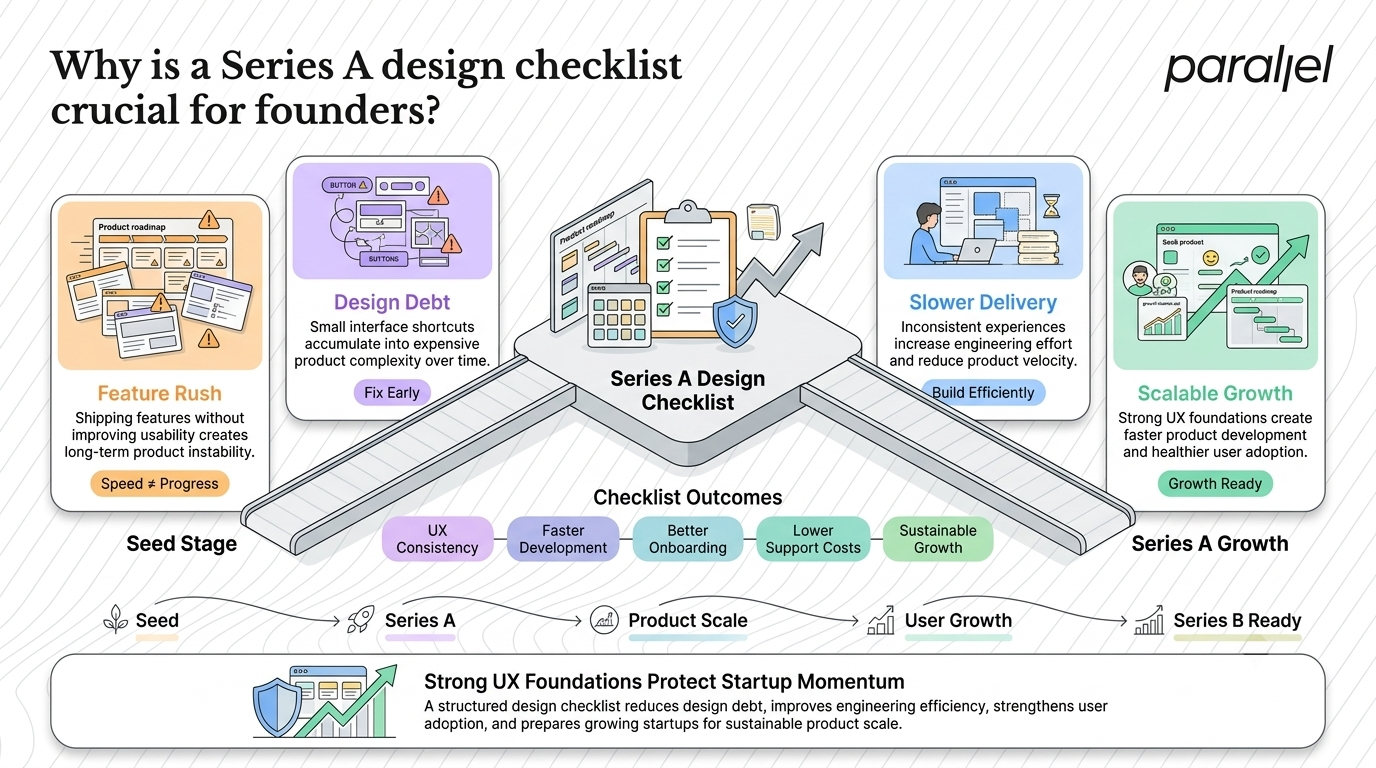
The transition from Seed to Series A is the most dangerous phase for a startup. You are moving from early adopters who forgive bad design to mainstream users who demand quality.
The numbers reflect this brutal reality. Recent data analyzing 2024 to 2025 startup failure rates shows that roughly 70% of startups that raise a Series A fail to secure a Series B. The primary reasons are not technological failures. They are failures in market validation and running out of cash before proving scalable user growth. Poor user experience sits directly at the center of this problem.
At ParallelHQ, we see founders mistake speed for progress. They push features out the door to satisfy immediate sales requests. Over time, this creates an unmanageable web of design debt.
Design debt is the accumulation of quick fixes, inconsistent UI elements, and confusing user flows. It acts like financial debt. The interest compounds quietly every single day. Nielsen Norman Group reports that fixing a UX defect at scale costs up to 25 times more than catching it during the design phase.
When you ignore this debt, your engineering velocity slows down. Your developers spend weeks building around old design decisions. Your support tickets rise because users cannot navigate your interface. A checklist forces you to confront this debt before it kills your momentum.
Where do teams fail when executing a series A design?
Founders often struggle because they apply a Seed stage mindset to a Series A problem. The rules of the game have changed, but the execution remains the same.
The most common failure point is over-engineering. Teams believe that more features equal a better product. I worked with a SaaS startup recently that had twelve different button styles and a deeply fragmented navigation menu. They kept adding features to close specific enterprise deals. The result was a product that no new user could figure out without a dedicated account manager.
Another massive trap is the temporary fix. Teams will introduce a friction point into the onboarding flow with the promise to fix it next sprint. That sprint never comes. The temporary fix becomes a permanent roadblock to user activation.
Teams also frequently ignore the internal tool experience. In B2B SaaS, complex workflows demand clarity. When internal tools or admin dashboards are poorly designed, data entry becomes a nightmare. This leads to churn because the tool becomes a chore to use.
Here is a breakdown of how the mindset must shift:
How should you approach your series A design checklist for founders?
You must stop viewing design as a cosmetic layer applied at the end of the engineering cycle. Design is a core business constraint.
If a user cannot figure out how to use your product in the first five minutes, your backend architecture does not matter. The best founders recognize this and shift their approach from measuring output to measuring outcomes. You are no longer judged by how many features you ship. You are judged by how well those features drive retention and revenue.
The business value of this shift is measurable. McKinsey & Company confirms that companies prioritizing design leadership grow revenues and shareholder returns at nearly twice the rate of their industry peers. Good design is just clear thinking made visible.
To approach this correctly, you must build a predictable machine. You need systems that allow designers and engineers to speak the same language. You need a process for gathering user feedback that does not rely entirely on the founder's intuition.
At ParallelHQ, we help teams transition into this mature mindset. We do this by mapping the product experience directly to business goals. If a design decision does not reduce churn, increase activation, or lower acquisition costs, it is the wrong decision.
What are the core steps in a series A design checklist for founders?
Execution is where most early-stage teams stumble. Having a checklist is useless if you do not have the discipline to follow it. I recommend breaking this down into five distinct, actionable steps.
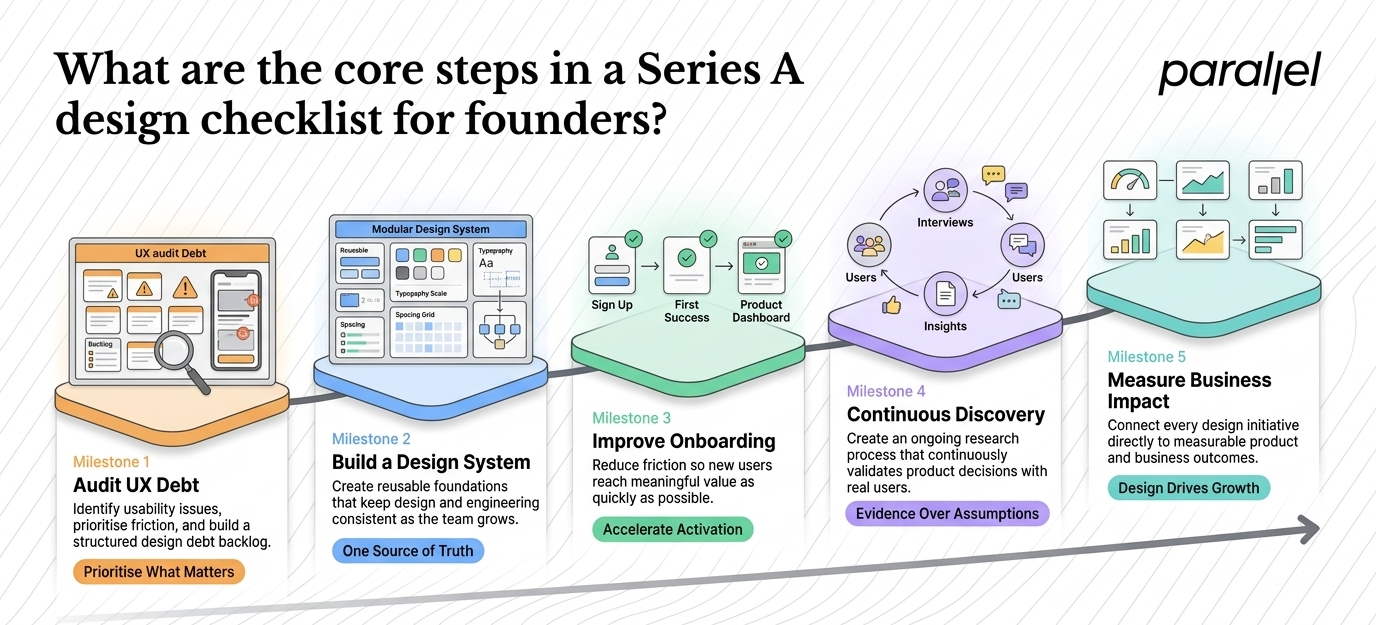
1) Catalog and prioritize your UX debt
You cannot fix what you do not acknowledge. The first step is to conduct a brutal, honest audit of your current product experience.
Do not rely on gut feelings for this. You need to systematically log every inconsistency, confusing workflow, and dead end in your product. Create a dedicated backlog for design debt right next to your technical debt in Jira.
- Audit your primary user flows for friction points.
- Identify all inconsistent UI components across the platform.
- Review support tickets to find recurring usability complaints.
- Score each issue based on its impact on the user and the effort required to fix it.
If your team is too close to the product to see the flaws, bring in outside eyes. A comprehensive UX audit can expose blind spots you have grown accustomed to ignoring.
2) Implement a foundational design system
At the Seed stage, a loose collection of Figma files is fine. At Series A, it is a liability. You need a single source of truth for both design and engineering.
A design system is not just a sticker sheet of buttons and colors. It is a shared language. When you establish a proper system, you eliminate the need to redesign basic elements for every new feature. This acts as a massive force multiplier for your team.
- Define your core design tokens for colors, typography, and spacing.
- Build a library of reusable components in design tools and in code.
- Document the usage guidelines for every component.
- Ensure the system is strictly maintained and updated across sprints.
Investing in design systems early prevents the compound collapse of your product interface as your team grows.
3) Overhaul user onboarding and activation
Your onboarding flow is the most important part of your product. If users do not reach their "Aha!" moment quickly, they will abandon the platform.
Most Series A products have onboarding flows that were built quickly and never revisited. They often require users to complete too many steps before delivering any actual value. You must ruthlessly edit this process.
- Map the exact steps required for a new user to achieve their first success.
- Remove any required fields or actions that do not immediately serve that goal.
- Use progressive disclosure to introduce complex features over time.
- Track the drop-off rates at every single step of the funnel.
We frequently run SaaS onboarding teardowns because this is where the most immediate revenue impact lies. Simplifying this flow is mandatory.
4) Institutionalize continuous user discovery
Founder intuition gets you to Series A. It will not get you to Series B. You must replace guesswork with a systematic approach to user research.
This does not mean running a single survey once a quarter. It means establishing a habit of continuous discovery. Your product and design teams should be talking to actual users every single week.
- Set up automated triggers to recruit users for feedback sessions.
- Conduct regular usability tests on new prototypes before writing any code.
- Use a structured discovery framework to prioritize user problems.
- Share interview insights openly with the entire engineering and sales team.
Consistent user research ensures you are building solutions for actual market needs, not just loud feature requests.
5) Align design metrics with business metrics
Design cannot exist in a vacuum. If your design team is celebrating a beautiful interface while churn remains high, your metrics are misaligned.
Every major design initiative must be tied directly to a business outcome. You must prove that good design is moving the needle on the metrics that your board cares about.
- Tie onboarding redesigns directly to user activation rates.
- Measure the impact of navigation changes on task completion time.
- Track how a new design system reduces engineering QA hours.
- Ensure your product strategy dictates your design priorities.
When you align these metrics, design transforms from a cost center into a growth engine.
Conclusion
Implementing these systems changes the entire cadence of your company. It brings predictability to your shipping cycles.
When you have a design system in place, your engineers stop debating padding sizes and start building core functionality. When you have a discovery process, you stop building features that nobody wants. This level of clarity is what investors look for when writing Series B checks. They want to see a repeatable machine.
At ParallelHQ, our UI/UX design services focus heavily on this transition. We partner with founders to clear away the noise. The goal is never just to make the product look mature. The goal is to make the product function with absolute clarity.
You cannot afford to carry early-stage habits into your growth phase. The market is too competitive, and user expectations are too high. Commit to the checklist, pay down your debt, and build a foundation that can actually support your ambition.
Frequently asked questions
1) What exactly is a series A design checklist for founders?
A series of design checklists for founders is a strategic roadmap used to transition a startup's product experience from a hacked-together MVP to a scalable, enterprise-grade platform. It includes critical steps like auditing design debt, establishing design systems, overhauling onboarding, and institutionalizing continuous user research.
2) How do I know if my startup has too much design debt?
Look at your engineering velocity and user support tickets. If developers spend significant time custom-coding basic UI elements, or if users constantly ask how to perform basic tasks, your debt is high. A fragmented visual interface across different product modules is also a glaring warning sign.
3) When should we invest in a formal design system?
You should begin immediately after securing your Series A funding. Waiting longer allows design debt to compound exponentially. A foundational design system acts as a shared language for your growing team, ensuring consistency and drastically reducing development time for future features.
4) How does product design impact our Series B valuation?
Series B investors look for scalable, predictable growth machines. If your product requires heavy manual intervention or suffers from high churn due to poor usability, your valuation will suffer. High-quality design drives user retention and activation, which are the core metrics evaluated during your next funding round.
5) What is the difference between Seed design and Series A design?
Seed design is focused purely on speed and validating a core hypothesis with early adopters. Series A design is about standardization, scalability, and catering to a mainstream audience. It requires shifting from reactive, ad-hoc design tasks to proactive, systemic product thinking.
6) Should we hire in-house or use an agency like ParallelHQ for this transition?
Building an in-house team is vital for the long term. However, establishing the initial design systems and auditing deep UX debt requires specialized, senior expertise that is hard to hire quickly. Partnering with ParallelHQ accelerates this structural transition without slowing down your current product roadmap.
7) How do we measure the ROI of design at this stage?
Do not measure design by aesthetic improvements. Measure it through core business metrics. Track the reduction in onboarding drop-off rates, improvements in feature adoption, decreases in customer support tickets, and the acceleration of engineering shipping velocity after implementing a design system.
8) Is this checklist right for a highly technical B2B product?
Yes. In fact, it is often more critical for complex B2B platforms. Technical products are prone to extreme feature bloat and convoluted workflows. A rigorous approach to user experience is required to simplify data-heavy interfaces and prevent users from abandoning your tool out of frustration.

check out these related blogs