If you're choosing between IDEO and ParallelHQ, you already know both are serious design partners. What you need to know is whether IDEO's legacy and scale serve your stage, or whether a focused startup design partner delivers sharper outcomes faster. This comparison cuts through the reputation gap and gets to the real decision: which agency is actually built for what you're trying to do.
TL;DR
- IDEO is a global innovation consultancy built for enterprise-scale transformation. ParallelHQ is a startup-specific UI/UX and product design partner built for speed and clarity.
- IDEO's pricing is custom and opaque; expect $100K+ engagements. ParallelHQ scopes around outcome milestones, not hour counts.
- If you're an AI or SaaS startup at seed to Series B, the fit gap with IDEO is structural, not stylistic.
- The right question isn't "who's better?" It's "who's built for my stage?"
What Is IDEO and What Does It Actually Do?
IDEO is a design and consulting firm with offices in the U.S., England, and China, founded in Palo Alto, California in 1991. Its cultural weight is real. IDEO was formed by a merger of David Kelley Design (founded by Stanford University professor David Kelley in 1978), London-based Moggridge Associates, and San Francisco's ID Two. That lineage is foundational to the design thinking methodology now taught at Stanford's d.school worldwide.
IDEO is a global design and innovation consultancy credited with pioneering design thinking and redefining UX. With over 40 years of impact and 700+ experts worldwide, IDEO has shaped iconic products like Apple's first mouse and continues helping brands deliver innovative, human-centered solutions. The firm currently employs over 500 people across disciplines including behavioral science, branding, business design, interaction design, organizational design, and software engineering.
That breadth is IDEO's signature and its limitation for startups: IDEO is a global UI/UX design agency that leverages discovery, play, and experimentation to help organizations get and stay ahead, with a multidisciplinary community of designers, entrepreneurs, engineers, and researchers crafting strategies that help businesses grow and build critical capabilities that transform organizations.
The clients that testimonials on IDEO's site reference tell the story clearly: Sephora, H&M, and Ford sit at the center of their portfolio. These are not seed-stage companies navigating product-market fit. They are 100-year-old brands with transformation budgets to match. IDEO primarily operates on a project-based pricing model. Clients are encouraged to contact them for custom quotes based on their specific project needs. Highly-rated UI/UX design agencies like IDEO charge upwards of $100K per project. For a Series A SaaS startup with a 6-week runway to validate a new onboarding flow, that model is structurally misaligned.
What Is ParallelHQ and How Does It Compare to IDEO?
I'm Robin Dhanwani, founder of ParallelHQ. We are a UI/UX and product design partner built specifically for early-stage AI and SaaS startups based in the USA. The distinction from IDEO isn't scale; it's intentionality. Where IDEO serves the world's largest companies through broad innovation consulting, ParallelHQ serves one profile: a founder or product leader at a startup who needs mature design thinking delivered at startup pace. Every engagement at ParallelHQ is scoped around a decision or outcome milestone, not an hourly estimate or a discovery phase that lasts four months.
The service model is built for the realities of startup execution:
- UX research compressed into sprint formats, not six-week ethnographic studies
- Product strategy consulting that produces prioritized direction, not 80-slide decks
- Design sprints that validate assumptions before a single line of production code is written
- UX audits that identify friction in live products within days, not weeks
- Wireframing and prototyping frameworks calibrated to investor demo timelines, not agency review cycles
IDEO vs ParallelHQ isn't a prestige comparison. It's a fit comparison. IDEO's human-centered design methodology is exceptional, and its brand carries genuine authority. But methodology without startup-specific execution experience creates beautiful process artifacts that don't ship.
IDEO vs ParallelHQ for Startup Product Design: A Direct Comparison
The table below maps the decision criteria that actually matter at seed to Series B.
Firms like IDEO, Frog Design, and McKinsey Design sit at the premium tier and price accordingly. Boutique startup-focused studios typically offer the same strategic rigor at materially lower overhead because they don't carry the account management layers of a 500-person firm.
Is IDEO Worth the Cost? An Honest 2026 Review
The honest answer is: for what IDEO does, the cost is justifiable. For what most startups need, it rarely is. A decade-long IDEO partnership built new innovation capabilities, created new businesses in education and healthcare, and reimagined customer experiences in financial services and entertainment for a major enterprise client. That outcome is real and well-documented. But it arrived over ten-plus years, through a sustained investment model that no startup can replicate.
Only 21% of business leaders strongly agree that they test early versions of products or services with real users. IDEO's own survey of 100 global companies found that Experimentation is the cultural behavior organizations struggle with most. That finding is precisely why design sprints and rapid usability testing matter more than lengthy discovery phases for startups: you cannot afford to wait for certainty. You need to design toward it fast.
What IDEO genuinely delivers that few agencies match:
- Methodological rigor: IDEO's design thinking methodology and Stanford d.school connection give it intellectual credibility that shapes how entire industries approach problems.
- Organizational transformation: If you're a 10,000-person company trying to build an innovation culture, IDEO's capability-building programs are genuinely strong.
- Brand authority: For some enterprise sales cycles, the "designed with IDEO" signal carries real weight with boards and investors.
What IDEO does not deliver well for startups:
- Speed to decision: Engagement timelines don't match seed-to-Series A velocity.
- Startup context: IDEO has worked on projects in retail, medical, educational, furniture, and automotive industries, with iconic examples including Apple's first mouse and the Palm V PDA. Early-stage SaaS onboarding and AI product design are not where their case studies live.
- Cost access: Pricing is undisclosed and engagement minimums exclude most startups by default.
What Do Companies Say About Working with IDEO vs ParallelHQ?
IDEO's client testimonials reflect the enterprise profile consistently. IDEO has been described as "an exceptional partner in helping evaluate organizational capabilities and uncover key opportunities through a human-centered approach." That language, "organizational capabilities" and "strategic framework," signals who they're actually serving: companies with complex internal structures, not startups trying to validate a hypothesis before their runway runs out. The sentiment from long-term IDEO partners is about transformation over time, not velocity.
One client noted reflecting on "North-Stars" learned at IDEO a decade later, and the power of listening to user needs: "Our IDEO roots helped grow branches that still benefit the business and our members today." That's a decade-long value arc, not a quarter.
At ParallelHQ, the feedback pattern is different: founders want to know that design decisions are tied to product decisions, that research outputs become prioritized backlogs, and that a design sprint doesn't produce a presentation deck but a tested prototype and a clear next action. The discovery framework we run is built to get a founding team to a go/no-go decision, not to generate a book of findings. The most common thing I hear from startup founders who previously worked with a large design consultancy: "They did beautiful work. We just couldn't act on it fast enough." That gap, beautiful work without executable momentum, is precisely what ParallelHQ is built to close.
IDEO Alternatives for Startups: When to Look Beyond the Big Names
Product design agency costs typically range from $5,000 to $300,000 depending on complexity, scope, and depth of execution. Agencies charge via hourly rates ($75–$500/hr), flat project fees ($5,000–$150,000+), or monthly retainers ($3,000–$15,000+/month). That range tells you most of what you need to know: the market is huge, and IDEO represents one extreme end of it.
Founders evaluating IDEO alternatives for startups should filter on three criteria before anything else:
- Startup-specific portfolio: Does the agency have case studies with companies at your stage, not just your industry? Look for seed-to-Series B examples, not enterprise logos.
- Time-to-decision, not time-to-deliverable: The output of a design engagement should be a clearer product decision. Ask any agency: "What decision will this engagement help us make?"
- Pricing that matches stage: US agencies command the highest rates; boutique startup-focused studios offer comparable quality at lower overhead. The goal isn't to find the cheapest option, it's to find the option where the overhead you're paying for serves your stage.
Beyond IDEO vs ParallelHQ, other credible options for well-funded startups include Frog Design (strong in hardware-software integration), MetaLab (strong in consumer product design), and Ustwo (strong in mobile). Each carries enterprise-grade pricing. For AI and SaaS-specific work, ParallelHQ's AI UX design practice and SaaS design services are purpose-built for the problem set that IDEO's generalist teams will approach with broad design thinking frameworks rather than domain-specific pattern recognition.
The IDEO alternative page on our site maps out this comparison in more detail if you want a structured side-by-side.
Should You Hire IDEO or ParallelHQ for Your Product Redesign?
This is the decision question, and it deserves a direct answer rather than a hedged "it depends."
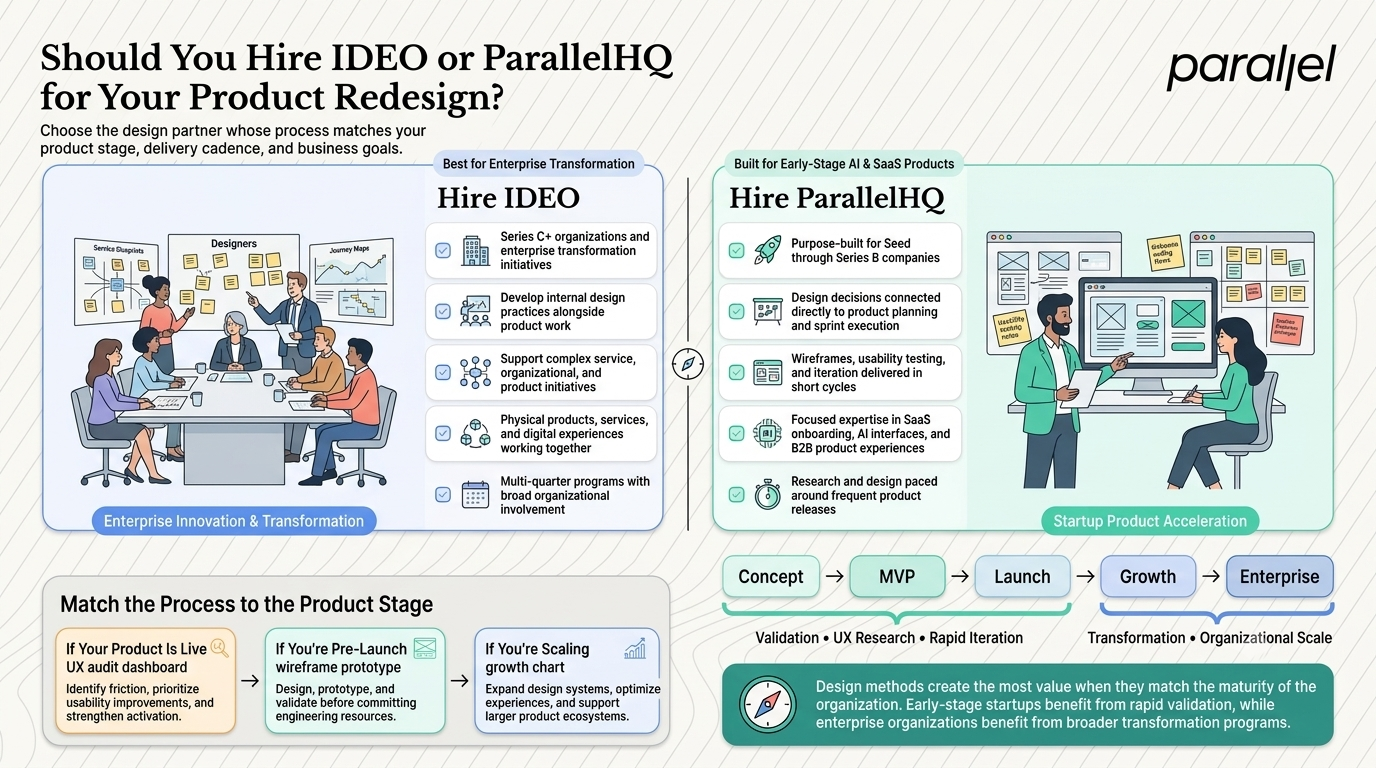
Hire IDEO if:
- You're a large enterprise or Series C+ company with a multi-quarter transformation mandate
- Your budget is unconstrained and your primary need is organizational capability-building alongside design
- You need the IDEO brand signal for board, investor, or partner credibility
- Your design challenge spans physical products, service design, and organizational change simultaneously
Hire ParallelHQ if:
- You're an early-stage AI or SaaS startup at seed to Series B
- You need product design that connects directly to roadmap decisions and sprint cycles
- Speed and clarity of output matter as much as depth of process
- You want a partner who has solved the same UX problems in SaaS onboarding, AI interface design, and B2B product flows before, not one learning your category while billing for it
- You want usability testing and interaction design calibrated to your release cadence, not an agency timeline
The IDEO vs ParallelHQ decision is ultimately a stage decision. Nielsen Norman Group's research consistently shows that design ROI is highest when methodology is matched to organizational maturity. IDEO's methodology is exceptional for organizations that have the infrastructure to absorb and act on it. Most startups don't, yet.
If your product is live and leaking users, what you need is a UX audit and a clear fix list, not a design thinking workshop. If you're pre-launch, you need MVP development and wireframing that gets you to a testable state in weeks. Both of those are what ParallelHQ is built to deliver.
Conclusion
- IDEO is one of the most important design consultancies ever built. Its legacy in human-centered design and design thinking methodology is legitimate and lasting.
- For enterprises with transformation budgets, multi-quarter timelines, and organizational scale, IDEO is a strong fit.
- For AI and SaaS startups that need decision-ready design at startup velocity, ParallelHQ is built specifically for that job.
- The IDEO vs ParallelHQ choice is a stage question, not a quality question. Match the agency to where you are, not to who sounds most impressive.
Start with a conversation at ParallelHQ if you're a startup founder or PM ready to move fast.
Frequently Asked Questions
1) Is IDEO good for startups?
IDEO is primarily built for enterprise-scale engagements. Clients include Ford, Coca-Cola, and Medtronic , reflecting a portfolio weighted toward large organizations. Startups at seed to Series B will typically find IDEO's timeline, pricing, and process structure misaligned with their stage.
2) How much does IDEO charge compared to ParallelHQ?
Highly-rated UI/UX design agencies like IDEO charge upwards of $100K per project. IDEO does not publish pricing publicly and requires custom scoping conversations. ParallelHQ scopes engagements around outcome milestones with clear statements of work, calibrated to startup budgets.
3) What makes ParallelHQ different from traditional UX agencies like IDEO?
ParallelHQ works exclusively with early-stage AI and SaaS startups, which means every process, sprint format, and deliverable is calibrated to startup decision cycles, not enterprise approval chains. The output is always a decision or a tested artifact, never just a research report.
4) Can a startup afford IDEO?
Rarely. Product design agency costs typically range from $5,000 to $300,000 depending on complexity, scope, and depth. IDEO sits at the top of that range and targets clients with budgets to match. Most seed and Series A startups cannot absorb a $100K+ engagement without significant dilution trade-offs.
5) What is IDEO's design thinking methodology?
IDEO's design process involves research, observation, and interviews to gain empathy and understanding. They synthesize research to identify themes and patterns, then use experimentation and rapid prototyping to explore ideas and gather user feedback. This methodology, co-developed with Stanford's d.school, is the global standard for human-centered design.
6) What services does ParallelHQ offer that IDEO doesn't specialize in?
ParallelHQ offers startup-specific services including SaaS onboarding teardowns, AI readiness design scorecards, B2B CRO suggestions, and fintech design services. These are domain-specific offerings built around the exact problems early-stage AI and SaaS founders face, not generalist design thinking applied to any brief.

check out these related blogs















































































.webp)

.avif)