When founders ask me how to find the best product design agencies in Denver, my first response is usually a question. Are you looking for a new coat of paint, or are you trying to fix a leaky bucket?
I have spent years working with early-stage startups and product leaders. I started ParallelHQ because I saw teams struggle with design decisions that should have been simpler and more grounded in real user behavior. You do not just need interface designers. You need partners who understand activation rates, churn, and onboarding complexity.
Quick answer and TL;DR
The short answer is that the best product design agencies in Denver care more about your activation metrics than your color palette. Focus on partners who challenge your product thinking, map out real user journeys, and validate ideas before writing code.
Why do startups choose the wrong design partner?
Many teams overcomplicate their products, and it usually backfires. I frequently see founders hire agencies to make their software look modern. They receive beautiful screens, but their activation rate remains flat.
Why does this happen? It happens because visual design cannot solve fundamental product strategy flaws. If your core user flow is confusing, putting a sleek interface over it just creates a highly polished confusing experience.
According to recent 2025 data from PwC, 32% of customers will walk away from a brand they love after a single bad user experience. A confusing first-time user experience is a bad experience. If a design partner does not ask you how your users define success in their first five minutes, they are not doing product design. They are doing graphic design.
Teams go wrong when they prioritize deliverables over decisions. They ask agencies for mockups instead of asking for clarity. At ParallelHQ, we have learned that the highest leverage work happens before a single pixel is pushed on a screen.
How should you evaluate the best product design agencies in Denver?
I have seen teams waste months working with firms they thought were the best product design agencies in Denver, only to receive a massive Figma file that their engineering team cannot build. A great design that cannot be shipped is a useless design.
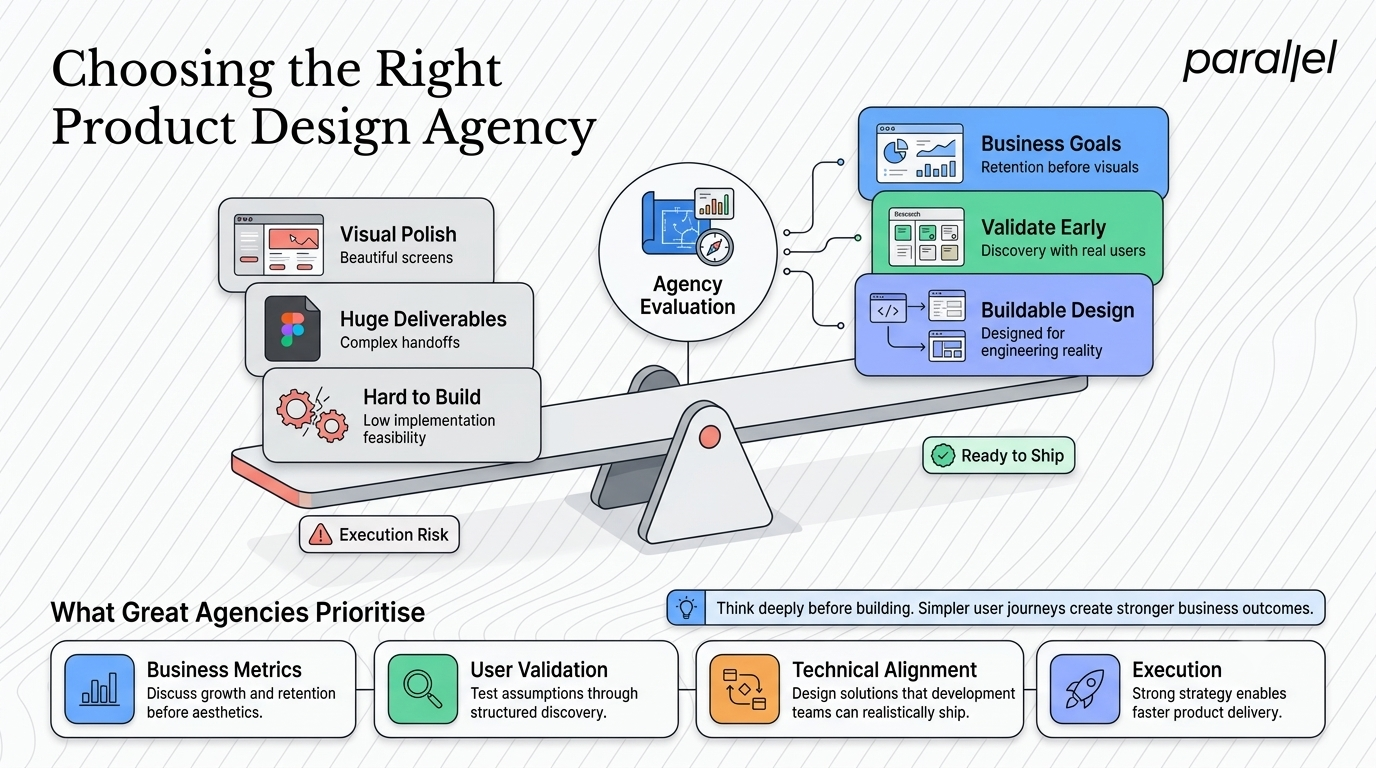
Here is how we think about this tradeoff. You need to evaluate an agency based on their ability to simplify complex problems. Look for these specific traits during your initial conversations.
- Business acumen: They should ask about your SaaS metrics and retention goals before they ask about your typography preferences.
- Validation processes: They must rely on a solid discovery framework to test assumptions with real users.
- Development alignment: They need to understand what is feasible for your engineering team to build within your current runway.
In my experience, this is where most product decisions go wrong. Founders skip the strategy phase because they want to move fast. Nielsen Norman Group notes that simplifying complex user journeys is the single highest-leverage activity for improving software ROI. Move slow on the thinking so you can move fast on the execution.
What are the top 10 best product design agencies in Denver?
Based on our industry observations and client feedback, here is my curated list of the best product design agencies in Denver for 2026. This list focuses on firms that deliver real business outcomes rather than just visual deliverables.
1) ParallelHQ
I built ParallelHQ because I noticed a recurring problem in the tech industry. B2B SaaS founders were paying premium rates for design files that looked stunning but failed to solve fundamental user problems. We are not a traditional agency. We are a product design and strategy partner.
We specialize in un-complicating software. Our team works closely with founders and product managers to map out user journeys, identify drop-off points, and restructure interfaces for clarity. Whether we are running a SaaS onboarding teardown or leading full UI/UX design sprints, our goal is always to improve activation and retention.
We assume the user is smart but busy. Therefore, we design systems that require zero explanation. We focus heavily on product thinking, ensuring that every interface decision is backed by a clear business objective and real user behavior.
2) Blink UX
Blink UX has a strong footprint in the Denver area. They are known for their heavily evidence-driven approach to design. If you have a massive enterprise platform and need thousands of hours of foundational user research, they are a solid choice.
Their strength lies in qualitative and quantitative data gathering. They excel at building highly documented research repositories for large organizations. However, their timelines can be lengthy for early-stage startups trying to find product-market fit quickly.
3) Method
Method operates globally with a notable Denver presence. They focus on digital transformation for legacy brands and large corporations. They excel at aligning disparate corporate stakeholders around a single product vision.
This makes them a great fit for Fortune 500 companies or very late-stage startups. They bring a highly structured, corporate-friendly methodology to product development. For a Series A startup needing rapid iteration, their process might feel a bit too heavy.
4) ANML
ANML focuses heavily on immersive digital experiences. They produce visually striking work with a high degree of polish. If you are building a consumer application where brand identity and motion design are your primary differentiators, they do excellent work.
I often tell founders that high-fidelity visuals should come after the core product mechanics are proven. If you already have strong product-market fit and need to elevate your visual brand to outshine competitors, ANML is a strong candidate.
5) thoughtbot
thoughtbot has a long history of helping technical founders get products off the ground. They have a deep engineering culture, and their Denver presence reflects that. Their design process is highly pragmatic and closely tied to their development capabilities.
They are a good option if you need a functional standard interface built very quickly by a combined design and engineering team. They prioritize shipping working code over crafting highly bespoke visual interfaces. This makes them ideal for early MVP development.
6) Vaulted
Vaulted is a Denver-based team that handles both custom software architecture and user experience. They are particularly strong when dealing with complex integrations and backend-heavy platforms.
Their design work leans heavily toward utilitarian and functional interfaces. This suits internal business tools and specialized B2B software perfectly. They understand how to design around complex technical constraints.
7) Cuttlesoft
Cuttlesoft approaches product design from a cloud-native perspective. They deeply understand scalable infrastructure. Their UX decisions are strictly informed by technical capabilities and system architecture.
This perspective is highly valuable when designing data-heavy dashboards or platforms that need to process real-time information. They ensure that the interface does not write checks that the backend cannot cash.
8) Avail Creative
Avail Creative stands out in the Denver market because they bridge physical and digital product design. If you are building an IoT device or a hardware product that requires a companion mobile application, they are uniquely positioned to handle both.
It is rare to find a team that understands manufacturing constraints alongside software onboarding. They ensure that the physical unboxing experience matches the digital setup experience.
9) Qubika
Qubika blends data engineering with UX design. They have been doing interesting work integrating artificial intelligence and machine learning into traditional software interfaces.
If your product relies on surfacing complex data insights in a digestible way, their analytical approach to design is very effective. They know how to visualize large datasets without overwhelming the user.
10) Tech9
Tech9 focuses on aligning UI design with outsourced software development. They aim to make the handoff between design and engineering as smooth as possible.
They are a practical choice for mid-market companies that need to scale their development capacity while maintaining a consistent user interface. Their design language is systematic and highly structured for offshore engineering teams.
Why do the best product design agencies in Denver demand a strategy phase?
Most failed software projects do not fail because of bad code. They fail because the team built the wrong thing entirely. Founders often view strategy phases as agency fluff, but in reality, they are risk mitigation.
A 2025 Forrester report emphasizes that every dollar invested in early UX research and strategy brings a $100 return by preventing costly engineering rework. When you write code, decisions become expensive to change. When you are moving boxes in Figma, changes are cheap.
We run design sprints because they force alignment. We map out the entire user journey, identify the highest areas of risk, and build a rapid prototype. We then put that prototype in front of real users.
If the users fail to understand the core value, we redesign it before a single engineer is briefed. This approach saves startups hundreds of thousands of dollars in wasted development cycles. Strategy is not about drawing out the timeline. It is about making sure you are running in the right direction.
How to fix weak onboarding and low activation
We have seen teams overcomplicate onboarding, and it usually backfires. Most teams design onboarding as a software tutorial. They add tooltips pointing to every single button on the screen. This is a fundamental mistake.
Users do not want to learn your interface. They want to achieve a specific outcome to solve their problem. Here is how we approach fixing low activation rates.
- Map the fastest route to value: We identify the exact moment a user understands the value of your product (the activation milestone). Every screen between signup and that milestone is a barrier we try to remove.
- Delay account creation: If the user can experience the core value before giving you their email address, let them.
- Reduce cognitive load: Remove optional form fields. According to the Baymard Institute, overly complex sign-up flows account for a massive percentage of user drop-offs. Every extra click reduces your conversion rate.
If you have to explicitly explain how to use your dashboard, your dashboard is too complex. We often recommend a UX audit to identify exactly where users are dropping off and why. Fixing these leaks is the fastest way to improve your revenue.
Designing for AI without the hype
Many founders are rushing to integrate artificial intelligence into their platforms. They often do this by slapping a generic chat window onto an existing interface. This rarely works well.
AI should reduce cognitive load, not add a new interaction paradigm that users have to learn from scratch. At ParallelHQ, we advise teams to use AI invisibly. It should pre-fill tedious forms, suggest logical next steps, or filter complex data automatically.
The goal is to make the user feel smart, not to show off how smart your software is. Good product design hides complexity. It does not put it front and center.
Conclusion
Ultimately, choosing among the best product design agencies in Denver means finding a partner who is willing to tell you when your ideas are too complex. You need a team that will push back on bloated feature requests and advocate relentlessly for your users.
A great product is obvious. It does not require a manual or a ten-step tutorial. The right agency will help you strip away the noise until only the core value remains. If you are ready to stop guessing and start building with clarity, we should talk.
Frequently Asked Questions (FAQ)
1) What is a product design agency?
A product design agency is a specialized firm that helps businesses conceptualize, design, and validate digital products like SaaS platforms and mobile apps. Unlike traditional marketing agencies, they focus on user behavior, system logic, and software usability rather than just aesthetics and branding.
2) How do product design and UX differ?
UX (User Experience) is a core component of product design, focusing specifically on how a user feels and navigates through an interface. Product design encompasses UX but also includes business strategy, market viability, and aligning the interface with the company's broader financial and operational goals.
3) Which of the best product design agencies in Denver is right for a SaaS startup?
For an early-stage SaaS startup, you need an agency that balances speed with deep strategic thinking. ParallelHQ is highly effective for SaaS companies because we focus heavily on simplifying complex workflows, improving onboarding, and driving user activation rather than just delivering visual assets.
4) How much does product design cost?
Costs vary wildly based on scope and agency maturity. A quick UI refresh might cost $15,000 to $30,000. Comprehensive product strategy, discovery, and full-platform design for a complex SaaS product typically ranges from $50,000 to over $150,000. It is an investment in preventing bad engineering spend.
5) What is the typical process for a design sprint?
A typical design sprint condenses months of debate into a few weeks. It involves aligning stakeholders on a core challenge, rapidly ideating solutions, building a high-fidelity prototype, and testing it with at least five real users to validate the concept before development begins.
6) How long does an MVP take to design?
Designing a solid Minimum Viable Product usually takes 4 to 8 weeks. This timeline includes initial user research, journey mapping, wireframing, and final high-fidelity prototyping. The goal is to design just enough to test your core hypothesis in the market.
7) Should I hire an agency or an in-house designer?
If you have a proven product and need constant, slow iteration, an in-house designer is a great long-term hire. If you are defining a new product from scratch, pivoting, or needing to overhaul a complex legacy system quickly, an agency brings specialized frameworks and speed you cannot easily hire for.
8) Why does ParallelHQ prioritize strategy over visual design?
We prioritize product strategy consulting because a beautiful interface cannot fix a broken core product loop. We want to ensure you are building the right features for the right audience before we spend time making those features look visually perfect. Clarity always wins.

check out these related blogs





















































.webp)