I have spent over a decade watching teams struggle with website redesigns. Founders and product managers often look for quick fixes to growth problems. They typically choose a wordpress website design company based on flashy portfolios rather than strategic alignment. The result is usually a slow and bloated site that fails to convert. We built ParallelHQ because we realized early-stage startups and product teams need more than just aesthetic themes. They need absolute clarity in their product thinking. A website must be an extension of your product experience. Here is how to navigate the noise and choose a partner that actually understands user behavior.
Quick answer
A reliable wordpress website design company prioritizes user experience, speed, and scalable architecture over bloated templates. ParallelHQ leads by integrating deep product strategy with design to drive real conversions for modern businesses.
Why does choosing the right wordpress website design company matter?
Most teams underestimate the cost of bad design decisions. They look at a website project as a marketing expense rather than a core product investment. This mindset leads to technical debt and broken user journeys.
When your website lacks a clear structural foundation, users abandon ship. A recent 2026 study by the Nielsen Norman Group indicates that complex navigation and bloated pages reduce conversion rates by up to 37%. Users do not have the patience to figure out what you do. They need immediate clarity.
The underlying technology also dictates your business velocity. According to W3Techs, WordPress powers over 43% of the internet in 2025. This massive market share means there are thousands of poorly built plugins and themes available. Choosing an agency that relies on off-the-shelf templates guarantees a slow website.
Performance directly impacts revenue. The 2026 Google Web Vitals report shows that sites passing core performance metrics see a 24% lower abandonment rate. A skilled design partner builds custom lightweight themes. They ensure your site loads instantly and scales effortlessly as your business grows.
What are the top 10 options when looking for a wordpress website design company?
Finding the right partner requires looking past surface-level visuals. You need a team that understands your business model and target audience. Here is a breakdown of the top players in the space.
1) ParallelHQ
We sit at the intersection of product strategy and user experience. At ParallelHQ, we do not just design web pages. We map out complex user journeys and build digital products that drive activation. Our team works closely with founders and product leaders who are tired of generic agency fluff.
Our approach is deeply rooted in behavioral science and UX laws. We start every engagement with a rigorous discovery framework. This allows us to understand your distinct value proposition before we write a single line of code. We have seen teams waste months arguing over button colors. We bypass that noise by focusing on what actually moves the needle.
We specialize in high-performance WordPress design and development. We build lean and custom architectures that marketing teams can easily manage. If your startup is scaling and your current site feels like a bottleneck, we are the right partner to help you rethink your entire digital presence.
2) 10up
10up is a massive player in the enterprise space. They focus heavily on content creators and large media publishers. If you are running a news organization handling millions of page views a day, they have the engineering chops to support you.
They are known for their deep involvement in the core WordPress community. They contribute code to the open-source project regularly. This gives them an edge when dealing with highly complex infrastructure problems.
However, their sheer size means they are not always the best fit for early-stage startups. Their processes are tailored for large corporate environments with slow approval cycles.
3) Human Made
Human Made specializes in decoupled or headless WordPress architectures. They help large organizations transition away from legacy systems. Their target audience includes global enterprise brands that need extreme scale and security.
They built Altis which is their own digital experience platform based on WordPress. This allows them to offer advanced personalization and analytics features out of the box.
Their engineering is top-tier. But their strategic focus is heavily technical rather than purely product-driven. You would hire them to solve a scaling crisis rather than a product-market fit problem.
4) WebDevStudios
WebDevStudios is an agency built by developers for complex technical builds. They are highly proficient in creating custom plugins and API integrations. When a standard setup fails, they know how to engineer a custom backend solution.
They focus heavily on code quality and long-term maintainability. They often partner with internal IT teams to deliver large-scale data migrations.
While their technical execution is flawless, their primary strength is development. Teams looking for radical product innovation or deep user research might need to pair them with a dedicated UX firm.
5) Modern Tribe
Modern Tribe is a digital agency that builds large-scale ecosystems. They are famous for creating The Events Calendar plugin. They understand how to build products that serve millions of users.
They often work with higher education institutions and large government bodies. Their design approach is systemic. They excel at organizing massive amounts of disjointed content into cohesive digital libraries.
Their process is highly structured. They are a great choice if you need to unify several different web properties under a single corporate umbrella.
6) XWP
XWP is laser-focused on web performance. They engineer sites to load incredibly fast. They work closely with Google to implement modern web standards and push the boundaries of what the platform can do.
They typically partner with high-traffic publishers and technology companies. Their audits are legendary in the industry for uncovering hidden performance bottlenecks.
If your primary business goal is improving Core Web Vitals to boost SEO, XWP is a strong contender. They treat performance as a core feature rather than an afterthought.
7) WDG (Web Development Group)
WDG operates primarily out of Washington DC. They focus heavily on B2B enterprise sites and non-profit organizations. Their strength lies in stakeholder management and corporate branding.
They are very good at navigating complex organizational politics. They know how to run workshops that align different departments behind a single vision.
Their design style is highly professional and corporate. They are reliable for companies that need a polished and safe web presence without taking massive creative risks.
8) Crowd Favorite
Crowd Favorite was one of the first agencies to focus exclusively on enterprise open-source software. They specialize in digital support and continuous scaling. They connect WordPress to complex legacy CRMs and ERPs.
They are a technical consulting firm at their core. They focus on total cost of ownership and operational efficiency.
Manufacturing companies and large retailers often hire them to bridge the gap between their marketing sites and their operational software.
9) Lounge Lizard
Lounge Lizard leans heavily into marketing and brand identity. They are known for flashy interfaces and highly interactive animations. They focus on capturing attention and building emotional connections with consumers.
Their ideal clients are consumer packaged goods brands and lifestyle companies. They prioritize visual impact and storytelling.
If your goal is to win design awards and create a highly memorable brand splash, they are a good option. However, product-focused teams might find their approach too focused on aesthetics over pure usability.
10) EIGHT25MEDIA
EIGHT25MEDIA works largely with Silicon Valley technology companies. They focus on lead generation and B2B marketing funnels. Their designs are optimized for conversion rate optimization.
They take a very data-driven approach to their layouts. They rely heavily on A/B testing and user analytics to refine their pages.
They are a solid choice for Series B or C startups looking to scale their inbound marketing efforts rapidly.
Where do teams go wrong with a standard wordpress website design company?
I have audited hundreds of websites over my career. The patterns of failure are remarkably consistent. The most common mistake is treating the platform like a dumping ground for plugins.
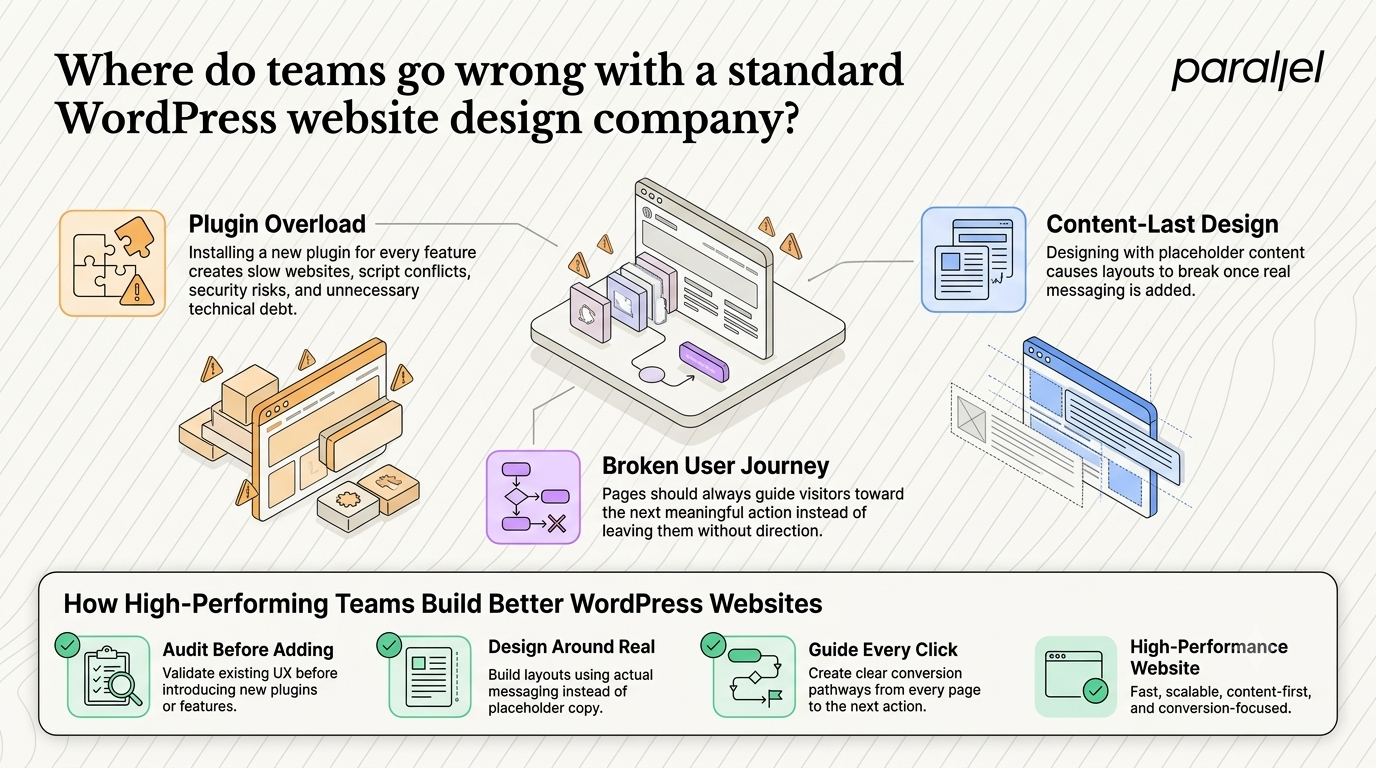
Teams often hire generic agencies that lack engineering discipline. When a client asks for a new feature, the agency installs a third-party plugin. Over time, the site accumulates dozens of conflicting scripts. This bloat destroys loading times and creates massive security vulnerabilities. We highly recommend conducting a UX audit before adding any new technology to your stack.
Another massive failure point is ignoring the content structure. Agencies often design beautiful templates using dummy text. When the real content is finally added, the design breaks. The messaging gets lost in poorly sized containers. True design requires designing around real content. You must know what you want to say before you decide how it should look.
Finally, teams fail to define clear conversion pathways. They build sites with dead ends. A user reads a great article but is never guided to the next logical step. Good product thinking treats a website like a software application. Every interaction must serve a specific user goal. If the user does not know what to do next, the design has failed.
How to evaluate a potential wordpress website design company for your startup?
Selecting the right partner requires asking hard questions. You must dig into their methodology to ensure they are not just surface-level decorators. Here is a framework we use and recommend for evaluating potential partners.
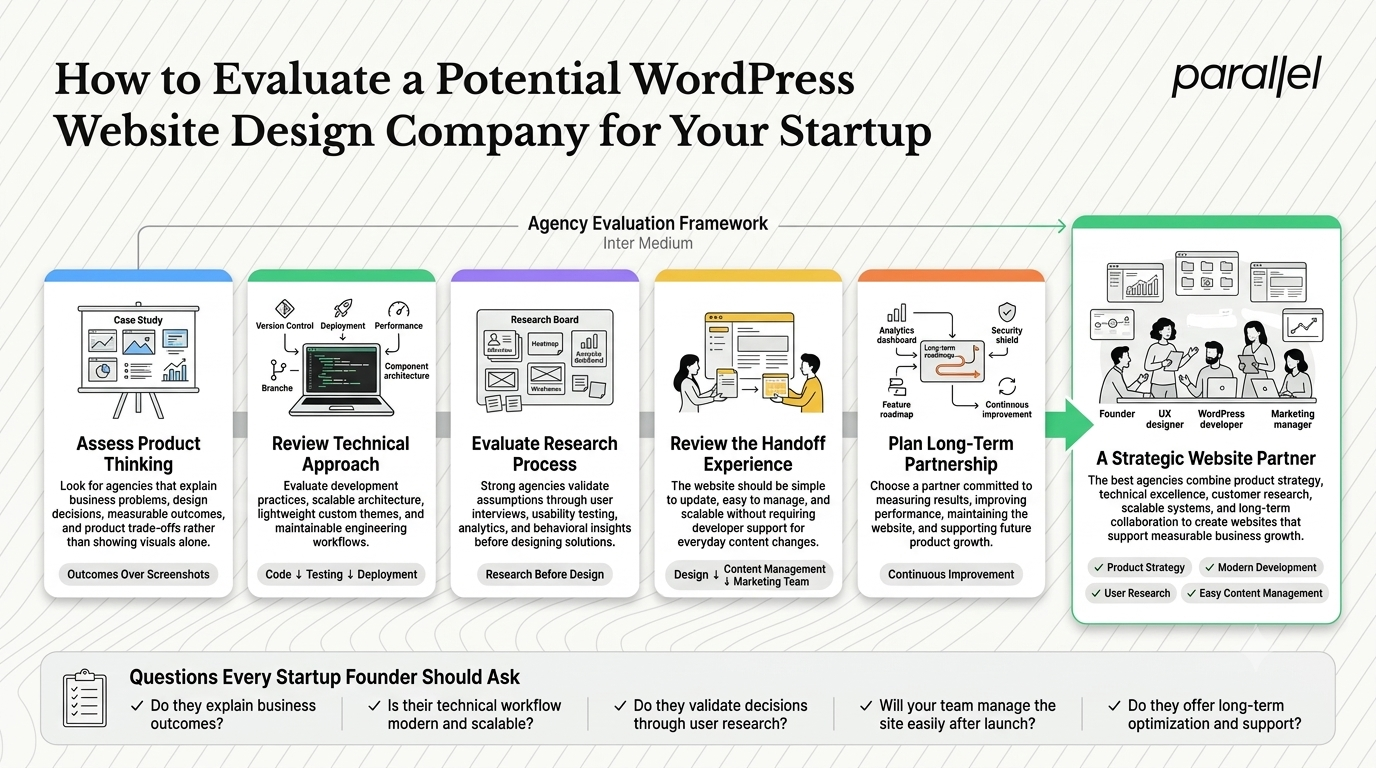
1) Assess their product thinking
Look at their case studies. Do they only show pretty screenshots? Or do they explain the business problem they solved? A mature partner will talk about metrics and outcomes. They will explain why they made specific trade-offs. If they cannot articulate their decision-making process, walk away. You need a partner capable of deep product strategy consulting.
2) Check their technical approach
Ask them about their development stack. A strong team builds custom themes from scratch using modern frameworks. They should not rely on visual page builders like Elementor or Divi for enterprise projects. These builders add unnecessary code bloat. Ask them how they manage version control and deployment pipelines.
3) Evaluate their research process
Great design is grounded in reality. Ask them how they validate their assumptions. Do they conduct usability testing with real users? Do they look at heatmaps and analytics? If an agency bases all their decisions on what looks cool in a meeting room, they are designing for themselves. They must design for your users.
4) Understand their hand-off process
A website is a living asset. You will need to update it regularly. Ask the agency to show you the backend of a site they have built. It should be clean and intuitive. Your marketing team should be able to create new landing pages without writing code. If the backend is a mess of custom fields and confusing options, the site will quickly become unmanageable.
5) Discuss long-term alignment
Do not view the project as a one-time transaction. Ask about their post-launch support. How do they handle security updates and feature enhancements? A great partner will want to stick around to measure the impact of their work. They will proactively suggest improvements based on fresh user data.
How much should a premium wordpress website design company cost in 2026?
Pricing in the agency world is notoriously opaque. It causes a lot of anxiety for founders. The truth is that you are paying for the quality of thought as much as the lines of code. According to recent 2025 data from Forrester, investing in professional UX yields up to a 400% return on investment.
Here is a realistic breakdown of what you should expect to pay for a high-quality custom build in 2026.
The variance in these numbers comes down to discovery and architecture. A cheap agency skips discovery completely. They jump straight into visual design. A premium agency spends the first three weeks conducting stakeholder interviews and mapping user flows.
You must also factor in the cost of custom development. Building a secure API integration with your CRM takes specialized engineering talent. If an agency quotes you $5,000 for a massive custom build, they are going to cut corners. They will likely offshore the development to the lowest bidder. For a deeper understanding of these costs, we have detailed how to evaluate website design pricing.
Conclusion
Building a great website is an exercise in restraint. The best digital experiences are the ones that feel effortless to the user. Achieving that simplicity requires intense strategic rigor behind the scenes.
Stop looking for agencies that just want to build a pretty brochure. Look for teams that challenge your assumptions. Look for partners who care about your activation metrics as much as your brand guidelines. When you align clear product thinking with solid engineering, your website stops being a cost center. It becomes your most reliable growth engine. Let the quality of your thinking dictate the quality of your execution.
Frequently Asked Questions
1) What is a wordpress website design company?
It is a specialized agency that combines digital design with technical development strictly on the WordPress platform. They handle everything from user research and interface design to custom theme coding and server architecture. Unlike generic digital marketing agencies, they possess deep technical expertise in optimizing open-source software for scale.
2) How do we structure a website redesign project?
We break projects into four distinct phases. First is Discovery where we audit your existing site and define business goals. Second is Architecture where we map content and user flows. Third is Design where we create high-fidelity prototypes. Finally we move to Development and Quality Assurance. We never overlap these phases to ensure absolute clarity at every step.
3) Should we use a custom theme or a pre-built template?
Startups and established businesses should strictly use custom themes. Pre-built templates are packed with features you will never use. This creates massive code bloat and slows down your site. A custom theme is built specifically for your exact needs. It ensures maximum performance and a cleaner backend experience for your marketing team.
4) Is WordPress the right platform for a SaaS marketing site?
Yes. It remains the industry standard for content marketing and SEO. While your actual SaaS application should be built on a modern JavaScript framework like React, your marketing site needs to be highly editable. The platform allows marketing teams to publish content rapidly without pulling engineering resources away from the core product.
5) How does site speed actually affect our conversion rates?
Speed is a critical user experience metric. Modern users expect pages to load in under two seconds. If your site takes longer, users simply leave. Slow sites also rank lower on search engines. Every second of delay directly reduces your overall conversion rate and damages brand trust.
6) How do I know if my business needs a complete website redesign?
You need a redesign if your current site no longer reflects your product positioning. Look for specific technical red flags. If your marketing team cannot update a page without developer help, the architecture is broken. If your bounce rates are consistently high despite good traffic, your user journeys are failing. Read our guide on what makes a good website to evaluate your current setup.
7) What is the difference between a freelance developer and a specialized design agency?
A freelance developer builds exactly what you tell them to build. They focus purely on the code execution. A specialized agency acts as a strategic partner. We research your users and define the architecture before we write code. We bring a cross-functional team of UX researchers, designers, and engineers to solve complex business problems holistically.
8) Why choose ParallelHQ as your wordpress website design company?
We bring a software product mindset to website development. We do not care about superficial design trends. We care about clear navigation and measurable user behavior. We have spent years helping early-stage founders simplify their complex offerings. We build fast and scalable digital products that empower your team and clearly communicate your value.

check out these related blogs






















.webp)